
Shipping car from Philadelphia to Los Angeles is mainly a scheduling and logistics problem, and the easiest way to save money is to stay flexible on pickup dates and choose open transport when it fits your car. If you understand the key players—shipper (you), broker, carrier, and the dispatcher/driver—you’ll know who’s responsible for pricing, timing, and paperwork.
For example, giving a 3–7 day pickup window often costs less than demanding “pickup tomorrow,” and meeting the driver at a truck-friendly spot can be cheaper than a tight residential street. In short: control the details you can (flexibility, service type, accurate vehicle info) and you’ll avoid overpaying and reduce surprises.
Shipping a car from Philadelphia to Los Angeles?
That’s a full cross-country move, so start with how to transport a vehicle to another state to understand the complete auto transport process.
For more coast-to-coast context, check:
Summary
Table of Contents
Quick Start: The 60-Second Game Plan (Beginner Summary)
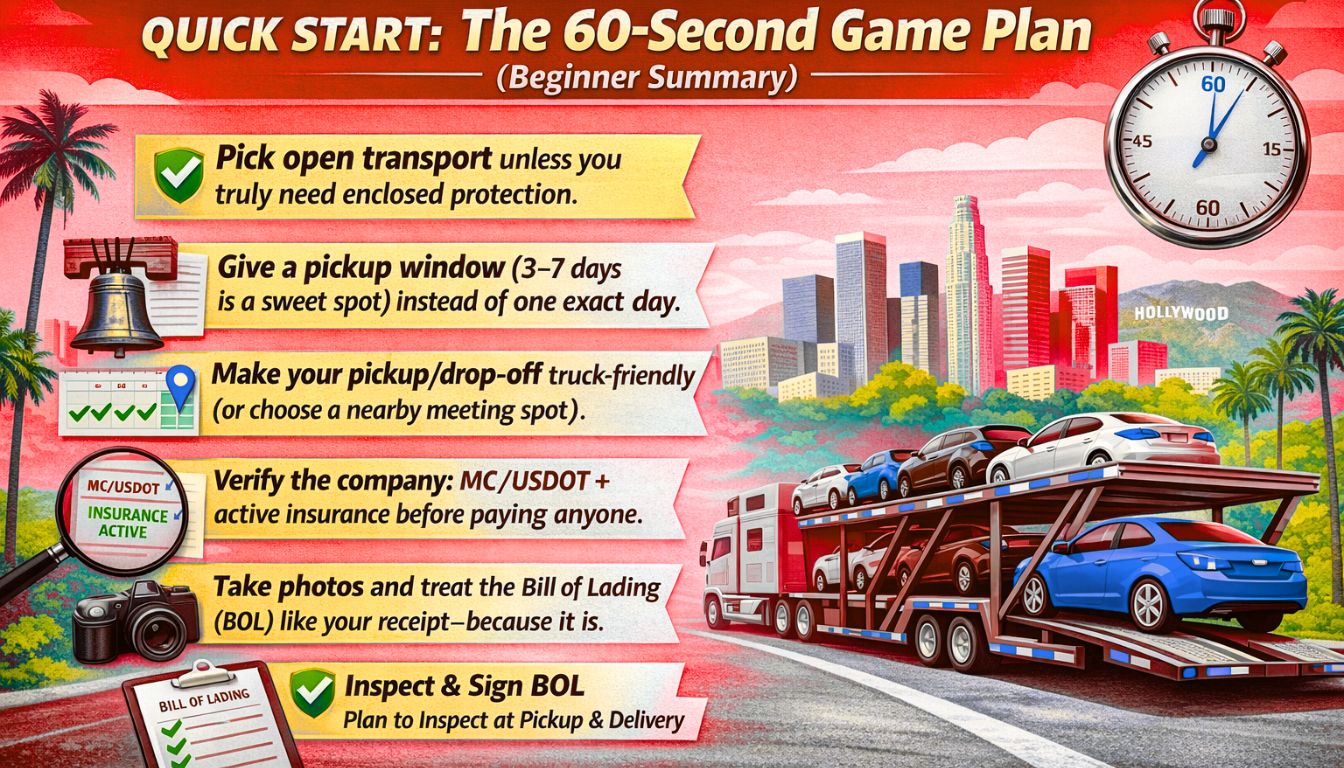
If you only read one section, read this:
- Pick open transport unless you truly need enclosed protection.
- Give a pickup window (3–7 days is a sweet spot) instead of one exact day.
- Make your pickup/drop-off truck-friendly (or choose a nearby meeting spot).
- Verify the company: MC/USDOT + active insurance before paying anyone.
- Take photos and treat the Bill of Lading (BOL) like your receipt—because it is.
Concrete example: If you’re available “any day next week” and can meet near a major road, you’ll usually pay less than someone who needs “Monday at 8:00 AM on a narrow residential street.”
How Car Shipping Works (Who Does What)
The key players
- Shipper (you): You provide the car, addresses, availability, and payment. You also prep the vehicle and sign paperwork.
- Broker (optional): A broker helps find a carrier for your route and coordinates the schedule. Some brokers collect a deposit.
- Carrier: The trucking company that physically moves your vehicle and carries cargo insurance.
- Dispatcher/Driver: The dispatcher schedules; the driver picks up, inspects, loads, delivers, and gets signatures.
The basic flow from quote to delivery
- Quote (based on route, timing, and vehicle details)
- Booking (you accept terms and set availability)
- Dispatch (matching your shipment to a truck)
- Pickup (vehicle inspection + BOL signed)
- Delivery (inspection + BOL signed)
Most first-timer headaches happen when people confuse dispatch time (finding a truck) with transit time (actual driving days).
Shipping Car From Philadelphia to Los Angeles: What to Expect on This Lane
Typical route realities (what affects timing)
This is a long, popular cross-country route, but timing still varies because trucks are balancing multiple pickups and deliveries.
- Dispatch time: can be fast or slow depending on demand and how flexible you are.
- Transit time: can shift due to weather, traffic, and DOT-required rest periods.
- Seasonal surges: summer moves, holidays, and snow seasons can affect both price and pickup speed.
If you’re researching pennsylvania to california car shipping, keep in mind that “PA to CA” demand is real, but exact ZIP codes and flexibility matter just as much as the state-to-state label.
Pickup and delivery locations matter more than most beginners think
Large carriers may not fit on certain streets. That’s not a scam—it’s physics and local access.
- Tight residential streets, low trees, or heavy traffic areas can force a meeting point nearby.
- A simple meeting point (like a big parking lot near a main road) can reduce delays and sometimes cost.
In cities like LA, being flexible about where you meet can be the difference between “delivered today” and “delivered after the next stop.”
Price Basics: What Moves Your Quote Up or Down
The biggest pricing factors (and how to use them to save)
- Pickup window flexibility: wider window usually lowers price.
- Open vs enclosed: enclosed costs more due to limited capacity and higher demand.
- Vehicle size/weight: bigger vehicles take more space and reduce trailer capacity.
- Operable vs inoperable: inoperable vehicles may require winching and extra time.
- Market demand + seasonality: more demand = higher quotes, especially on popular lanes.
Example: A standard sedan that runs well, shipping open, with a flexible pickup window, is typically the “best case” for pricing. A large SUV that doesn’t start, needs enclosed, and must be picked up tomorrow is the “most expensive” setup.
Deposits, payment methods, and why “cheapest” can become expensive
Many setups involve a deposit and then the remaining balance due later (often at pickup or delivery, depending on the company’s process). What matters is clarity:
- What exactly is the deposit for?
- Is it refundable if you cancel?
- When is the remaining balance due?
- Are there processing fees for certain payment types?
If someone can’t explain payment timing in one or two sentences, treat that as a red flag.
Service Options (Choosing the Right Fit as a First-Timer)
Open vs enclosed transport
- Open car transport: most common, usually the lowest cost, great for daily drivers.
- Enclosed car transport: higher protection, higher price—best for classic, luxury, exotic, or show cars.
If your car is a normal commuter vehicle, open shipping is usually the smart choice.
Door-to-door vs terminal-to-terminal
- Door-to-door: most convenient. If access is tight, you’ll meet nearby.
- Terminal-to-terminal: can work for some people, but it can also add steps, hours restrictions, and possible storage fees.
Terminal options can help in specific situations, but they’re not automatically cheaper once you factor in your time and potential fees.
Common Mistakes That Cost Beginners Money
First-time shippers often overpay because of avoidable issues:
- Giving an overly strict pickup time (“must be Tuesday at 9 AM”)
- Not disclosing that the car is inoperable, modified, or very low clearance
- Using hard-to-access locations with no meeting-point plan
- Not understanding the paperwork process (photos + BOL)
- Chasing the lowest number instead of verifying legitimacy
This is why pennsylvania to california auto transport quotes can vary a lot even for similar vehicles—small details change the “real” job for the carrier.
Broker vs Carrier (How to Decide)
- A broker can be helpful when you want more scheduling options, better lane coverage, or you don’t want to call multiple carriers yourself.
- A carrier direct option can be great if the carrier runs your route frequently and has availability.
Either way, your protection comes from the same core steps: verify operating authority, confirm insurance, and document the vehicle at pickup and delivery.
Comparing Philadelphia to Los Angeles with other East–West routes?
Use broad guides like East Coast to West Coast car shipping , plus similar cross-country lanes such as New Jersey to California and Virginia to California .
The 15 Money-Saving Tips for First-Time Shippers
Tip 1: Shipping Car From Philadelphia to Los Angeles — use a wider pickup window to cut costs
If you can offer a 3–7 day window, carriers can fit you into an existing route more easily. Less friction often means a better price.
Tip 2: Choose open transport unless your vehicle truly needs enclosed
Open shipping is the default for a reason: it’s widely available and usually the best value.
Tip 3: Confirm operable status honestly
If the car won’t start, steer, and brake normally, say so up front. “Surprise inoperable” often triggers extra fees or delays.
Tip 4: Pick truck-friendly pickup and delivery spots
If your street is tight, plan a meeting point near a main road. This can prevent “can’t access” delays.
Tip 5: Compare quotes with identical details
Same ZIP codes, same time window, same vehicle condition. Otherwise you’re not comparing the same job.
Tip 6: Understand the deposit before you pay it
Ask: Is it refundable? What happens if pickup takes longer than expected? What if I cancel?
Tip 7: Verify MC/USDOT and active insurance
Don’t skip this. It’s the cheapest “insurance” you can buy—because it prevents expensive disasters.
Tip 8: Ask about cargo insurance limits and exclusions
Get clear answers on coverage limits and what isn’t covered. Don’t assume personal items are protected.
Tip 9: Take timestamped photos before pickup
Walk around the vehicle and capture all angles, wheels, bumpers, and any existing scratches.
Tip 10: Treat the Bill of Lading like your receipt
At pickup and delivery, check the condition notes and make sure anything you see is documented.
Tip 11: Don’t pack personal items unless you have written approval
Many carriers restrict them. Even when allowed, they’re often not covered and can complicate claims.
Tip 12: Keep fuel around 1/4 tank
Enough to load/unload safely, not so much that you add unnecessary weight.
Tip 13: Have keys ready and plan for smart keys
Know how many keys you’re providing, and keep a spare plan so you’re not stuck.
Tip 14: Watch for red flags in “too-good-to-be-true” quotes
Pressure tactics, vague paperwork, no proof of authority/insurance, and unrealistically low pricing are common warning signs.
Tip 15: Separate “dispatch time” from “transit time”
If you need guaranteed fast pickup, that’s usually an expedited service—expect to pay more.
Copy/Paste Checklist (Before You Book)
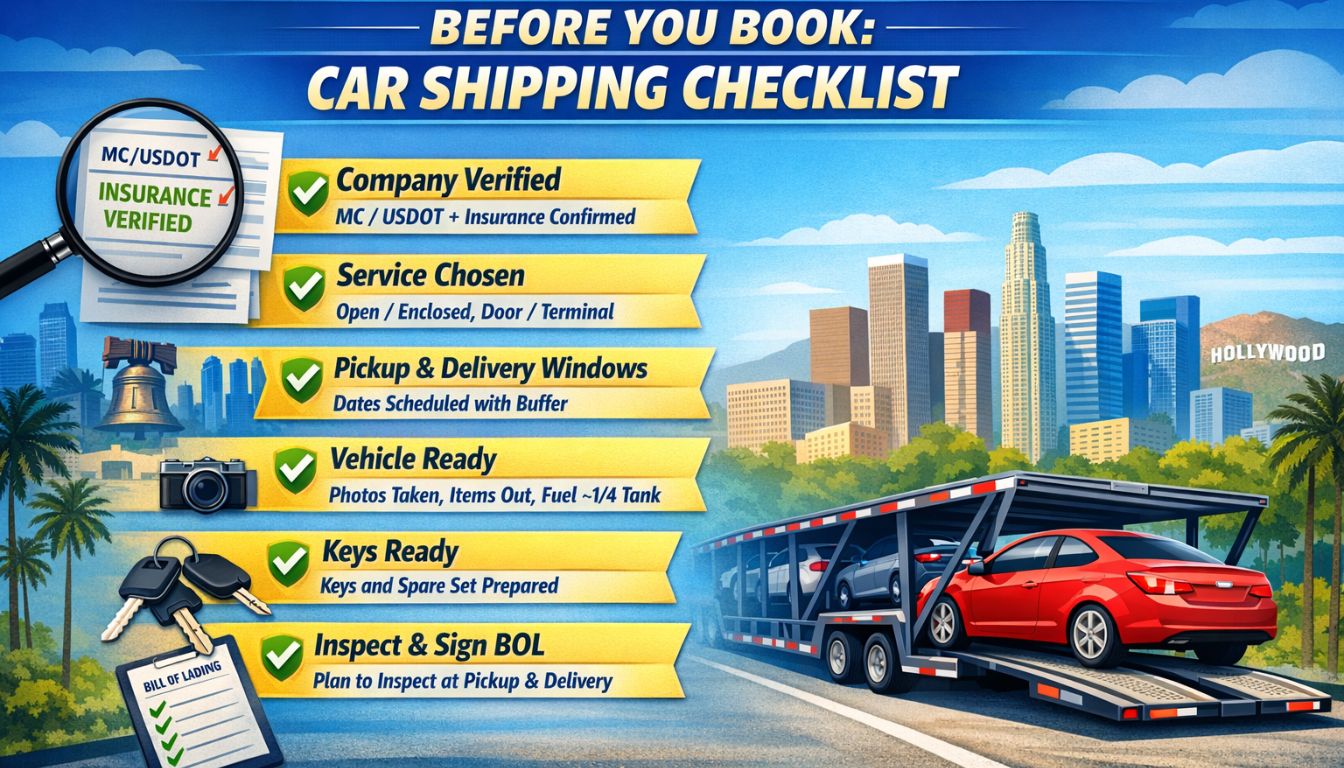
- Company verified (MC/USDOT + insurance matches the company name)
- Service chosen (open/enclosed + door/terminal + meeting point if needed)
- Pickup/delivery windows realistic (with buffer)
- Vehicle ready (photos taken, items removed, fuel ~1/4 tank)
- Keys ready (and a spare plan)
- Plan to inspect and sign the BOL at pickup and delivery
Beginner FAQ
How long does it usually take?
It depends on dispatch timing plus transit time. Flexibility usually speeds up matching and helps avoid premium pricing.
What affects price the most?
Flexibility, open vs enclosed, operable status, vehicle size, and seasonality.
Can I track the shipment?
Many companies provide updates via text/call through dispatch. “Real-time GPS tracking” varies by provider.
What if there’s damage at delivery?
Document it immediately on the BOL, take photos, and follow the carrier’s claims steps. Timing and paperwork matter.
Can I cancel or reschedule?
Usually yes, but fees depend on the contract and whether a driver has been assigned.
How much does it cost to ship a car from Philadelphia to Los Angeles?
Most first-time shippers pay based on five things: your pickup window, open vs enclosed transport, vehicle size/operability, exact ZIP codes, and seasonality. The fastest way to get an accurate price (and avoid surprise fees) is to request a quote using your real vehicle details and your preferred dates. Get your instant quote here.
Wrap-Up
For first-timers, saving money isn’t about chasing the lowest quote. It’s about using the right levers—flexibility, truck-friendly locations, accurate vehicle details—and protecting yourself with verification and documentation.
Do those things well, and shipping a car cross-country becomes straightforward, not stressful.
Final steps to ship your car from Philadelphia to Los Angeles
Revisit the fundamentals in how to transport a vehicle to another state , then confirm your quote by comparing it with other East–West corridors like: