
If you need to ship car to california, you probably don’t want a long lecture—you want a clear plan that gets your vehicle delivered safely, on time, and without surprise fees. Maybe you’re also wondering what is the cheapest way to ship a car or even what is the best car shipping company for your route and timeline.
The problem is that California moves attract tons of quotes, mixed advice, and fine print that can change your final price—especially when details like vehicle size come into play (yes, people ask what is considered an oversized vehicle because it can trigger higher rates and different trailer options). Add pickup windows, open vs enclosed, and broker vs carrier into the mix, and it’s easy to overpay or book the wrong service.
In this guide, you’ll get a simple, step-by-step breakdown of the best shipping methods, how to compare quotes the smart way, what actually impacts your price, how to spot legit carriers, and a quick checklist to prep your car for pickup and delivery.
Table of Contents
Table of Contents
What “ship car to california” really means (so you book the right thing)
When people say ship car to california, they usually mean professional auto transport—a licensed carrier moving your vehicle on a multi-car trailer. The most common variations you’ll see (and should understand) are:
- Open auto transport (most popular, best value)
- Enclosed auto transport (extra protection, higher cost)
- Door-to-door (pickup/delivery near your addresses)
- Terminal-to-terminal (drop off/pick up at facilities)
- Broker vs carrier (who you book with vs who drives the truck)
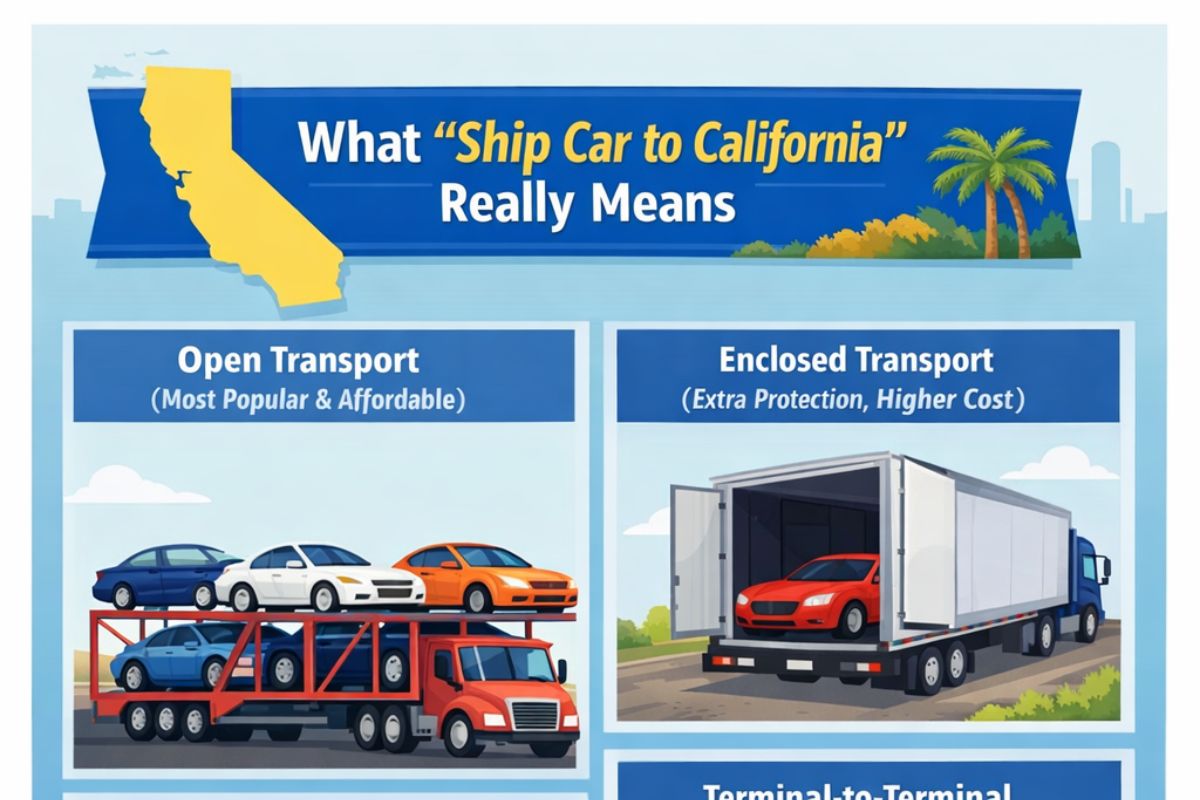
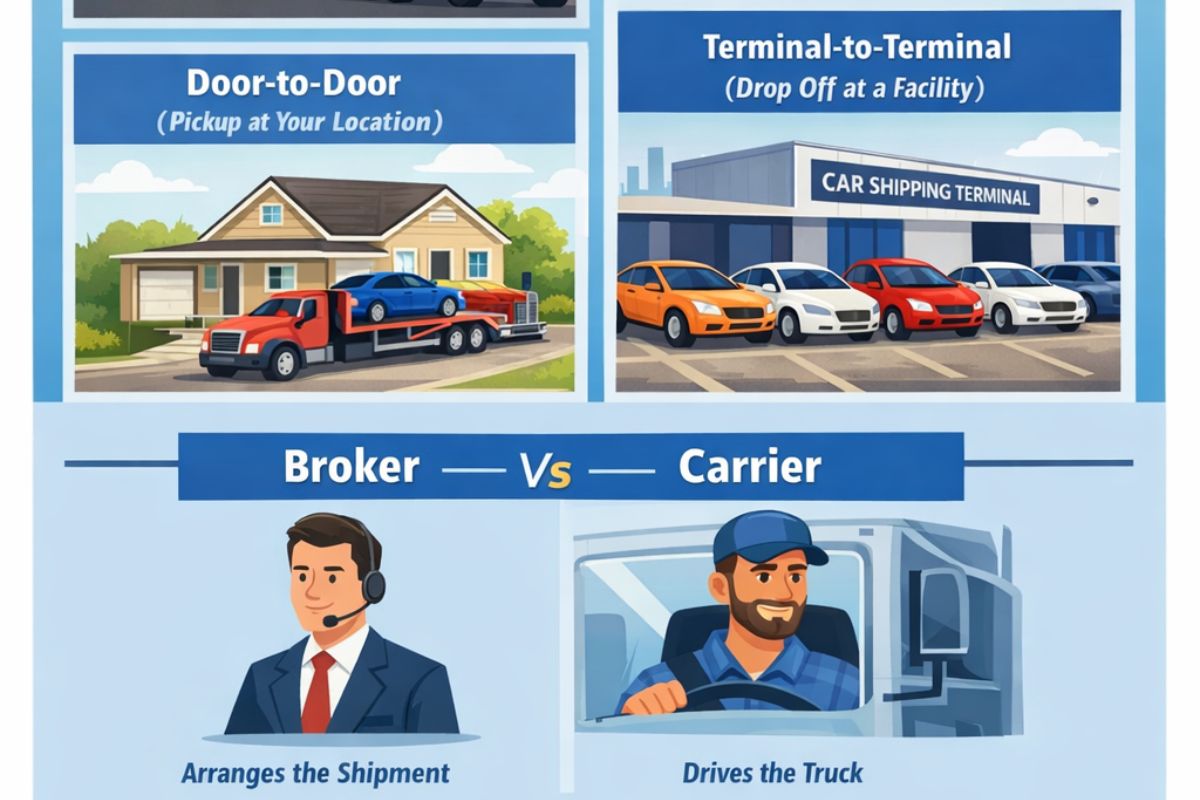
Bottom line: Your price and experience depend less on “finding a magic company” and more on choosing the right method + timeline + verification process.
Step 1: Choose the transport type (Open vs Enclosed)
Think of this like moving your TV. You can move it in the back of a pickup, or you can bubble-wrap it and put it in a protected box. Both work—one is simply more protective.
Open transport (best for most relocations)
If you’re trying to ship car to california for a normal daily driver, open transport is typically the smartest balance of cost and availability.
Best for:
- Sedans, compact SUVs, most mid-size SUVs
- Budget-focused moves
- Faster scheduling (more trucks available)
Tradeoff: your car is exposed to road dust and weather, which is normal and expected.
Enclosed transport (for high-value or sensitive vehicles)
Enclosed transport is the “protected box.” Choose it when the vehicle value (financial or sentimental) makes the extra cost worth it.
Best for:
- Classic cars, luxury/exotic cars, show cars
- Low-clearance vehicles
- Fresh paint or special finishes
Quick decision rule: If you’d be heartbroken or financially stressed by even minor cosmetic risk, price enclosed.
Step 2: Decide door-to-door vs terminal (based on your moving day reality)
For relocation, door-to-door usually wins because it reduces coordination during a chaotic move.
Door-to-door is ideal if:
- You’re packing, traveling, closing, or starting a new job
- You need fewer handoffs and simpler scheduling
- You don’t want to arrange rides to a terminal
Terminal-to-terminal can make sense if:
- You’re extremely price-sensitive
- Your pickup/delivery area has tight streets, restrictions, or limited access
- You can easily reach a terminal without stress
Important: “Door-to-door” rarely means “right in front of your exact door.” It typically means as close as a safe, legal spot allows (especially in dense areas).
Step 3: The quote process (how to compare apples to apples)
Most people get overwhelmed because they compare quotes that aren’t built on the same details. If you want to ship car to california without price surprises, you need consistent inputs.
Give every company the same info:
- Pickup ZIP/city and delivery ZIP/city
- Year/make/model
- Operable vs inoperable (runs/drives/brakes)
- Trailer type (open/enclosed)
- Desired pickup window (try 3–7 days if possible)
- Modifications (lift kit, oversized tires, roof rack, etc.)
Pro tip: A wider pickup window can reduce cost and increase carrier availability for ship car to california routes.
Step 4: What drives the cost to ship a car to California
Pricing isn’t random. It’s basically logistics math: route demand + trailer space + timing.
Key price factors:
- Distance and lane (popular routes are often smoother)
- Pickup window (flexible is cheaper than exact-day)
- Seasonality (summer and peak moving periods can rise)
- Vehicle size (standard vs oversized)
- Vehicle condition (inoperable often costs more)
- Trailer type (enclosed costs more than open)
- Origin/destination access (rural or restricted areas can add cost)
What is considered an oversized vehicle (and why it matters)
This question matters because “oversized” can change how many vehicles fit on a trailer. Fewer cars per run = higher cost per vehicle.
What is considered an oversized vehicle? Common examples:
- Full-size SUVs (larger body footprint than mid-size)
- Full-size pickup trucks
- Vans
- Dually trucks
- Lifted vehicles
- Oversized tires or wide body kits
- Roof racks/roof boxes that affect loading clearance
Do this: Tell the company upfront if your vehicle is large or modified. “Surprises” often become re-quotes later.
Step 5: Broker vs carrier (so you know who’s accountable)
When you ship car to california, you might book with:
- Carrier: owns the truck and moves the vehicle
- Broker: coordinates the shipment and assigns a carrier
A broker can be helpful (more access to capacity), but only if they’re transparent.
Ask these direct questions:
- “Are you a broker or the carrier?”
- “When will I receive the carrier’s DOT/MC and insurance?”
- “Is this price guaranteed, or can it change after dispatch?”
Green flag: clear answers + written terms.
Red flag: pressure to pay before details are confirmed.
Step 6: Verify legitimacy (avoid scams and bad operators)
If you’re relocating, this step protects your time and your vehicle.
Minimum verification checklist:
- DOT/MC number (broker or carrier)
- Authority status (active)
- Insurance (cargo coverage and limits)
- Company identity consistency (name, phone, paperwork match)
- Written terms: cancellation policy, payment method, pickup window
Where to verify:
- FMCSA / SAFER for DOT/MC and authority basics
Non-negotiable: If a company won’t share DOT/MC or insurance details, don’t book.
Step 7: What is the cheapest way to ship a car (without gambling)
People ask this because they want savings and safety. Here’s the realistic answer for ship car to california:
What is the cheapest way to ship a car? Usually:
- Open transport
- Flexible pickup window (3–7 days)
- Operable vehicle
- Standard-size vehicle
- Booking early (not last-minute)
- Major metro lanes (more trucks = better availability)
What looks cheap but often backfires:
- The lowest quote with unclear terms
- A “too-good-to-be-true” exact-day promise
- Not disclosing oversized features or inoperable condition
Best value mindset: Aim for fair price + proven process, not the lowest number.
Step 8: What is the best car shipping company (how to choose with criteria)
The “best” isn’t a brand name—it’s a company that does the basics flawlessly.
What is the best car shipping company for your move? The one that:
- Communicates clearly and quickly
- Provides written terms and expectations
- Verifies DOT/MC and insurance without hesitation
- Has a realistic pickup window and delivery process
- Uses a professional inspection + Bill of Lading (BOL) workflow
Use this quick scorecard:
- Clarity: do they explain open vs enclosed, broker vs carrier, timeline?
- Transparency: do you get carrier info and insurance proof?
- Professionalism: do they confirm details and access issues upfront?
- Realism: do they avoid “guarantees” that sound like marketing?
- Support: can you reach someone when plans change?
Relocation truth: A slightly higher quote can be cheaper than a low quote that causes delays, rescheduling, and stress.
Step 9: Prep your car (10-minute checklist that prevents disputes)
Before pickup:
- Wash the vehicle (photos show condition better)
- Take photos/video: all sides, wheels, roof, close-ups of existing marks
- Remove personal items (many carriers won’t cover them)
- Keep fuel around 1/4 tank
- Disable alarms if needed
- Ensure the car can be accessed (keys ready, battery healthy)
Important: Items inside the car can create delays or refusals, and coverage may not apply.
Step 10: Pickup day (the Bill of Lading is your receipt)
The Bill of Lading (BOL) documents the vehicle condition at pickup and delivery.
At pickup:
- Walk around the car with the driver
- Ensure existing marks are noted
- Confirm delivery contact and best phone number
- Keep a copy/photo of the signed BOL
At delivery:
- Inspect before signing final acceptance
- Compare with pickup photos and BOL notes
- If something’s wrong, note it immediately on paperwork
Simple analogy: The BOL is like the “move-in inspection checklist” for an apartment. If it’s not written down, it’s harder to prove later.
Step 11: Transit expectations (stay calm, stay informed)
When you ship car to california, timing can shift due to routing, weather, traffic, and dispatch schedules.
What’s normal:
- Updates when the carrier is assigned
- A call/text ahead of delivery
- Delivery at a nearby safe spot if access is limited
Smart move: Have a backup contact person in case you’re in a flight, closing, or job orientation.
Common mistakes that make California shipping harder than it needs to be
- Choosing the lowest quote without verification
- Expecting exact-day pickup on a budget rate
- Not disclosing oversized/modified details
- Skipping photos and rushing the BOL
- Booking before receiving clear written terms
Quick tables (cost factors and timeline reality check)
Cost factors for “ship car to california”
| Factor | Usually lowers cost | Usually raises cost |
|---|---|---|
| Trailer type | Open transport | Enclosed transport |
| Pickup timing | Flexible window | Exact-day pickup |
| Vehicle condition | Operable | Inoperable |
| Vehicle size | Standard sedan | Oversized vehicle |
| Route | Major metro lanes | Rural / restricted access |
| Season | Lower-demand periods | Peak moving season |
Typical transit time ranges (route-dependent)
| Origin region → California | Typical range |
|---|---|
| Southwest (AZ/NV/UT) | ~2–5 days |
| Texas / Central | ~3–7 days |
| Midwest | ~4–9 days |
| East Coast | ~6–12 days |
| Pacific Northwest | ~2–6 days |
Final recap (the “smart way” in one minute)
To ship car to california the smart way, choose open vs enclosed based on vehicle value, pick door-to-door if your move is tight, gather comparable quotes with the same details, disclose oversized or modified features, verify DOT/MC and insurance through FMCSA sources, document condition with photos, and treat the Bill of Lading like your relocation receipt.
Do that, and ship car to california becomes a controlled process—not a stressful mystery.
Frequently Asked Questions
Do I need insurance to register a car in CA?
Yes—California requires “financial responsibility” (usually auto liability insurance) for any vehicle operated or even parked on California roads, and DMV can suspend registration if it doesn’t receive proof of insurance. California DMV+1
Good to know:
Your insurer typically reports coverage electronically to the DMV. California DMV+1
“Full coverage” (comprehensive/collision) is optional, but it doesn’t replace the required liability coverage. California DMV+1
Why is California car registration so expensive?
Because CA registration is not just one fee—it’s a bundle of charges that can stack up, including: registration fee, CHP fee, vehicle license fee (VLF), transportation improvement fee (TIF), and county/district fees. California DMV
What usually drives it up the most:
VLF is based on the vehicle’s value (a percentage of purchase price/value). California DMV
TIF increases by vehicle value tiers (higher-value cars pay more). California DMV
Late penalties can grow quickly if you miss the due date. California DMV
Who has the cheapest shipping rates in the US?
For car shipping, there’s no single company that’s always the cheapest—rates change based on lane (route), season, vehicle size, trailer type, and how flexible your pickup window is. Cars.com+1
To get the cheapest legit rate most of the time:
Choose open transport (usually the most budget-friendly option). uShip
Be flexible with dates (wider window = more carrier options). Cars.com
Compare multiple quotes, but be cautious with the lowest offer—super-low prices are a common setup for “bait-and-switch” scams. kiplinger.com