
Shipping a car to another state can be smooth and predictable, or it can turn into a stressful mess of missed ETAs, surprise fees, and “wait… is that a new scratch?” moments. The difference usually comes down to three things:
- Choosing the right people (carrier/broker/driver)
- Controlling the handoffs (pickup, loading, delivery)
- Documenting everything (so problems get solved fast)
Shipping to another state? Here’s how car shipping works in 3 simple steps so you can book with confidence.
Learn the 3 steps →Below are 15 practical tips that reduce the two biggest risks: damage and delays.
Summary
Table of Contents
Tip 1: Decide your service level based on risk, not just price
- Open transport is the most common and budget-friendly.
- Enclosed transport lowers exposure to weather and debris and is best for classics/exotics/high-value vehicles.
- Door-to-door is convenient but depends on street access.
- Terminal-to-terminal can be cheaper, but adds handling steps and potential storage time.
If your priority is “no drama,” pay a little more for the service type that matches the car’s value and your timeline.
Tip 2: Vet the company like you’re hiring someone to move a fragile object (because you are)
Before you book, confirm:
- DOT/MC authority
- Active cargo insurance
- Real reviews (patterns matter more than star rating)
- Clear terms for pickup window, cancellations, and payments
The fastest way to invite delays is booking with someone who can’t actually cover your route.
Tip 3: Don’t shop on “lowest price”—shop on “most believable plan”
A quote that’s way under market often means:
- The carrier isn’t truly available yet
- The timeline is unrealistic
- There are hidden add-ons (inoperable, remote area, fees)
Ask: “What pickup window are you confident about, and why?” A good answer references route timing, truck availability, and lane demand.
Tip 4: Confirm whether you’re dealing with a broker or a carrier
Either can be fine—what matters is transparency:
- Carrier: owns the truck/trailer and directly handles the move
- Broker: matches you with a carrier in their network
If it’s a broker, ask how they vet carriers and how communication works once a driver is assigned.
Tip 5: Lock in realistic pickup and delivery windows (and build buffer)
Most delays happen because customers plan their entire life around an overly optimistic ETA.
Do this instead:
- Keep a 2–3 day buffer around pickup
- Keep a 1–3 day buffer around delivery (more for long routes or winter months)
- Avoid booking around critical deadlines unless you pay for a true expedited plan
Tip 6: Choose pickup/delivery locations that are easy for big trucks
Even “door-to-door” often becomes “door-to-nearby” if:
- Streets are too narrow
- There are low wires/trees
- HOAs restrict large trucks
- The truck can’t safely turn around
Pro move: pick a safe staging area (large parking lot near you) and reduce rescheduling risk.
Tip 7: If shipping from an auction or dealership, confirm release rules early
Auctions and dealerships cause delays when:
- The car isn’t “released” in their system yet
- Appointments are required
- Limited hours or closed days block pickup
Call ahead, confirm: required paperwork, buyer numbers, keys location, and appointment windows.
Tip 8: Clean the car before pickup (it’s not vanity—it’s evidence)
Dust hides scratches. A quick wash makes inspections more accurate.
At minimum:
- Wash exterior
- Remove heavy dirt around bumpers/wheels
- Make sure existing chips and scuffs can be seen in photos
Tip 9: Photograph the car like an insurance adjuster would
Take photos in good light:
- All 4 sides + front + rear
- Close-ups of existing damage
- Wheels/tires
- Roof/hood/trunk
- Odometer
- Any special areas (spoilers, splitters, mirrors)
These photos reduce “he said / she said” at delivery.
Tip 10: Do a pre-shipment inspection checklist (fast, but thorough)
Before pickup:
- Check tire pressure (helps loading)
- Ensure battery is healthy (or tell them it isn’t)
- Set fuel to about 1/4 tank
- Note any warning lights or mechanical quirks
If the vehicle is inoperable (even “it runs but barely”), say it upfront—surprises at pickup can cause delays or extra fees.
Before you book, confirm vehicle operability, exact addresses, and your pickup window. Follow these steps to ship a car to avoid surprises.
Get the step-by-step →Tip 11: Remove (almost) everything from inside the car
Personal items can:
- Shift and cause interior damage
- Increase weight
- Create theft risk
- Be excluded from cargo coverage
If you must keep anything inside, keep it minimal and confirm the policy in writing.
Tip 12: Disable alarms and provide clear key instructions
A constantly-triggering alarm is a real-world delay.
- Disable the alarm (if possible)
- Provide a working key fob (fresh battery)
- Provide a spare key if available (separately, if you can)
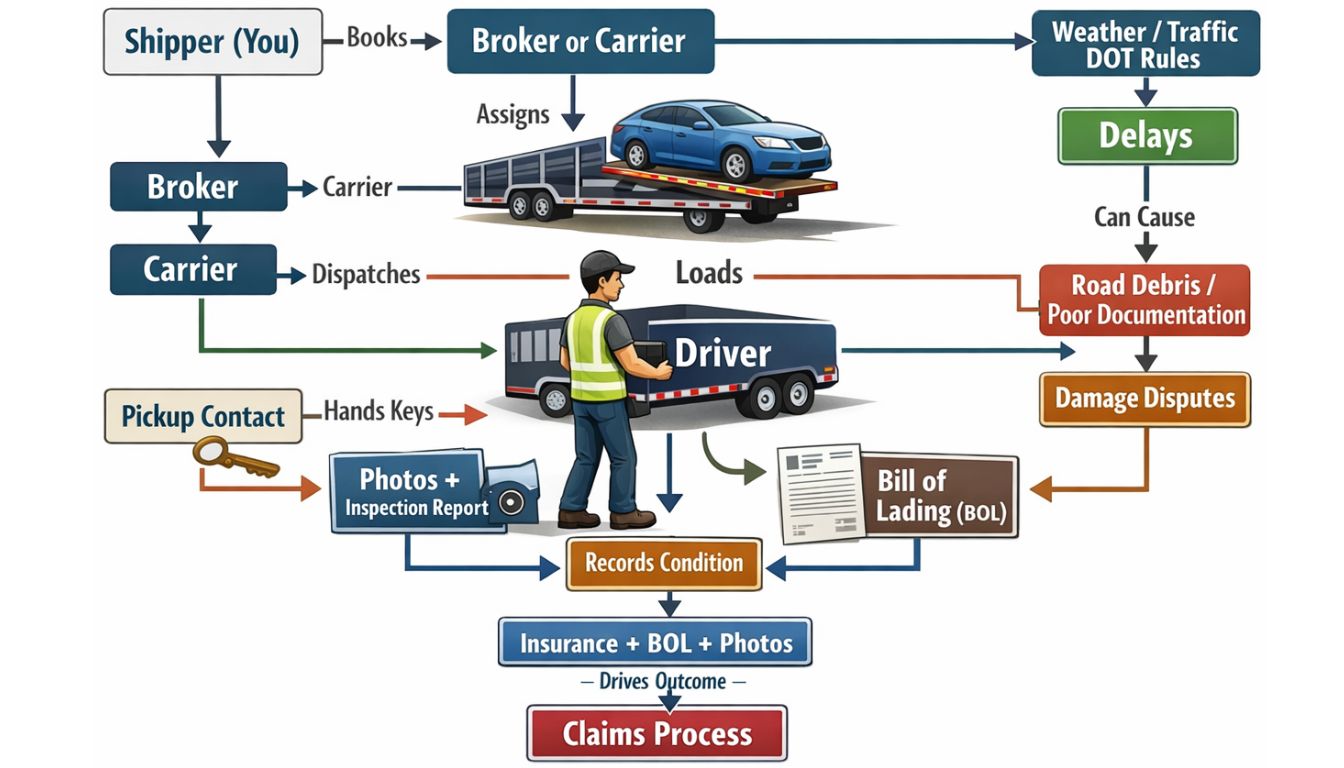
Tip 13: Understand the Bill of Lading (BOL) like it’s the “receipt of condition”
The BOL is the most important document in the entire shipment.
- At pickup: condition is recorded + signed
- At delivery: condition is confirmed + signed
If you find new damage at delivery, it should be noted on the BOL before signing (or clearly signed “with exceptions,” depending on how the form is structured).
Tip 14: Communicate with one clear point of contact
Confusion creates delays. Choose one person to coordinate:
- Your dispatcher/broker contact
- The driver (once assigned)
- Pickup contact
- Delivery contact
Share:
- Accurate addresses
- Gate codes / access instructions
- Best phone numbers
- Time windows
Make it easy for the driver to succeed.
Tip 15: Do a calm, methodical post-delivery inspection before you “close it out”
When the car arrives:
- Inspect in good light if possible
- Compare against your pre-shipment photos
- Check the same angles and close-ups
- Confirm mileage and general condition
If something is off: document immediately (photos + notes) and follow the claim instructions right away.
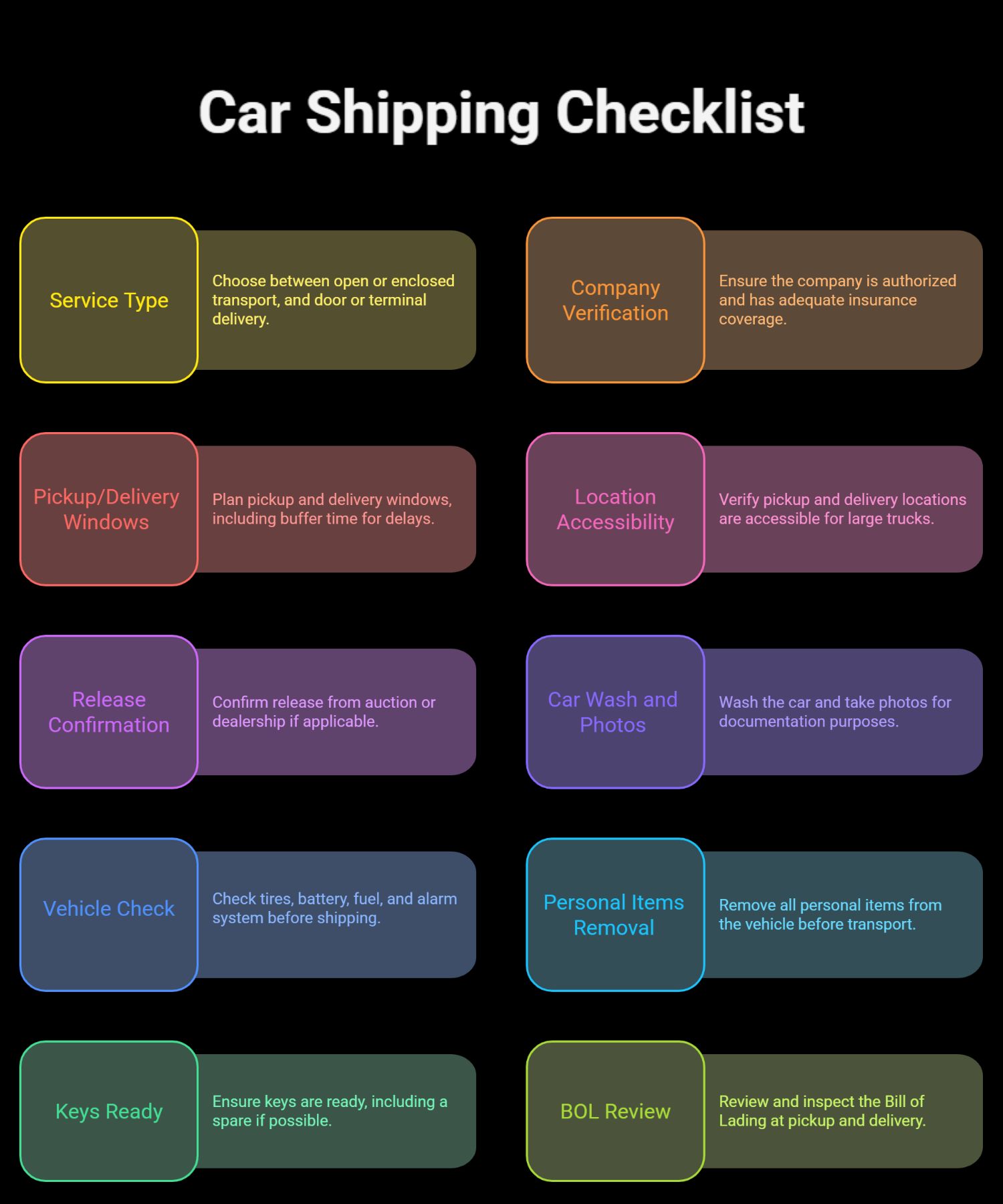
Quick checklist:
Tables (pricing + timing factors)
What affects price the most?
The biggest factors are distance, route demand, vehicle size/weight, transport type (open vs enclosed), and how flexible your pickup window is. The farther the trip and the harder the lane to cover, the more the price usually goes up. For example, shipping a sedan 500 miles on an open trailer with a 5–7 day pickup window is typically cheaper than shipping an SUV 1,500 miles enclosed with a 1–2 day pickup window. If you want the lowest rate, choose open transport, stay flexible on dates, and avoid peak seasons when possible.
| Factor | Usually increases price when… | Why it matters |
|---|---|---|
| Route / lane demand | Popular seasons, scarce carrier supply | Fewer trucks available = higher rates |
| Vehicle size/weight | SUVs, trucks, vans | Takes more space/weight capacity |
| Operability | Inoperable or “barely runs” | Needs winch/special handling |
| Service type | Enclosed or expedited | Less capacity, higher protection or priority |
| Pickup/delivery access | Remote areas, hard access streets | More time/risk to load and deliver |
What causes delays the most?
| Cause | Where it happens | How to reduce it |
|---|---|---|
| Unrealistic pickup window | Before pickup | Book a believable plan + buffer days |
| Auction/dealership release issues | Pickup | Confirm rules + paperwork early |
| Weather/road closures | Transit | Avoid tight deadlines; plan seasonal buffer |
| DOT hours-of-service limits | Transit | Expect stops; long routes need flexibility |
| Hard-to-access delivery | Delivery | Use a staging area/meeting point |
FAQ – Ship car to another state
Is open transport safe?
Yes for most daily drivers. The tradeoff is exposure to weather and road debris, similar to normal driving.
Should I ship enclosed for a normal car?
Usually not necessary unless you’re highly risk-averse, the car is high-value, or it has delicate paint/finish.
Can I put items in the car?
Sometimes, but it’s risky and often not covered. Too much weight can also cause refusal or extra fees.
What’s the single best way to avoid damage disputes?
Clean photos + a clear BOL at pickup and delivery.
Why do timelines change even with a scheduled pickup?
Carrier routing, DOT driving limits, weather, and other pickups/drop-offs on the route can all shift the schedule.
Auto transport cost: How much does it cost to ship a vehicle and how much does it cost to transport a car?
These questions mean the same thing—you’re asking about the overall auto transport cost. Pricing usually depends on distance, vehicle size/weight (sedan vs SUV/truck), operable vs inoperable condition, open vs enclosed transport, how flexible your pickup window is, and seasonal demand. The more space, handling, or urgency required, the higher the cost tends to be.
How accurate is a car shipping estimate calculator, and what affects a car shipping estimate?
A car shipping estimate calculator is great for getting a quick ballpark, but the final price can change based on real-time carrier availability on your route. To generate a solid car shipping estimate, you’ll usually need origin/destination ZIP codes, vehicle details, whether it runs and drives, your preferred dates, and the transport type (open or enclosed, door-to-door or terminal).
How much is it to ship a car and how much will it cost to ship a car if I choose open vs enclosed transport?
Both questions are asking for the expected total. In most cases, open transport is the most affordable option because it’s widely available. Enclosed transport typically costs more because it offers greater protection from weather and road debris and has limited capacity—making it popular for luxury, classic, exotic, or show cars.
How much to transport a car — and how much would it cost to ship a car — with door-to-door service, terminals, or an inoperable vehicle?
The price changes based on logistics. Door-to-door is convenient, but tight streets, HOAs, or low-hanging wires can require a nearby meeting point, which can affect timing and cost. Terminal shipping can sometimes lower the price on certain routes, but it may add handling steps and storage fees. If your car is inoperable, expect a higher quote because it usually requires special equipment like a winch for loading and unloading.
Ready to ship your car without stress?
If you want a shipment plan that prioritizes safe handling + reliable scheduling, get a quote and have your route reviewed before you book.
- Door-to-door service (open or enclosed)
- Clear inspection + BOL process to help avoid disputes
- Support available 24/7