

How much to ship a car to California depends less on “the distance” than on the fine print that most quotes don’t explain.
If you’re relocating across the country, the cost to ship a car from Florida to California can vary based on timing, vehicle type, and pickup flexibility.
If you’re moving a vehicle from South Florida to Santa Monica, it’s common to see prices in the $815–$1,150 range—often with the same promises: a 1–7 day pickup window and “3–4 days” of transit time.
The catch is that two offers that look identical can produce totally different outcomes: last-minute price changes, delays, or a claims nightmare if something gets damaged.
That’s because how much to ship a car to California is shaped by details like broker vs carrier, open vs enclosed transport, schedule flexibility, and what “fully insured” actually means (spoiler: the phrase alone is meaningless without real coverage limits and a clear claim process).
In this guide, you’ll learn why how much to ship a car to California varies, the red flags to avoid, and the questions to ask so your pickup dates, price, and protection are in writing—before you hand over the keys.
Table of Contents
Table of Contents
Quick answer: how much to ship a car to California?
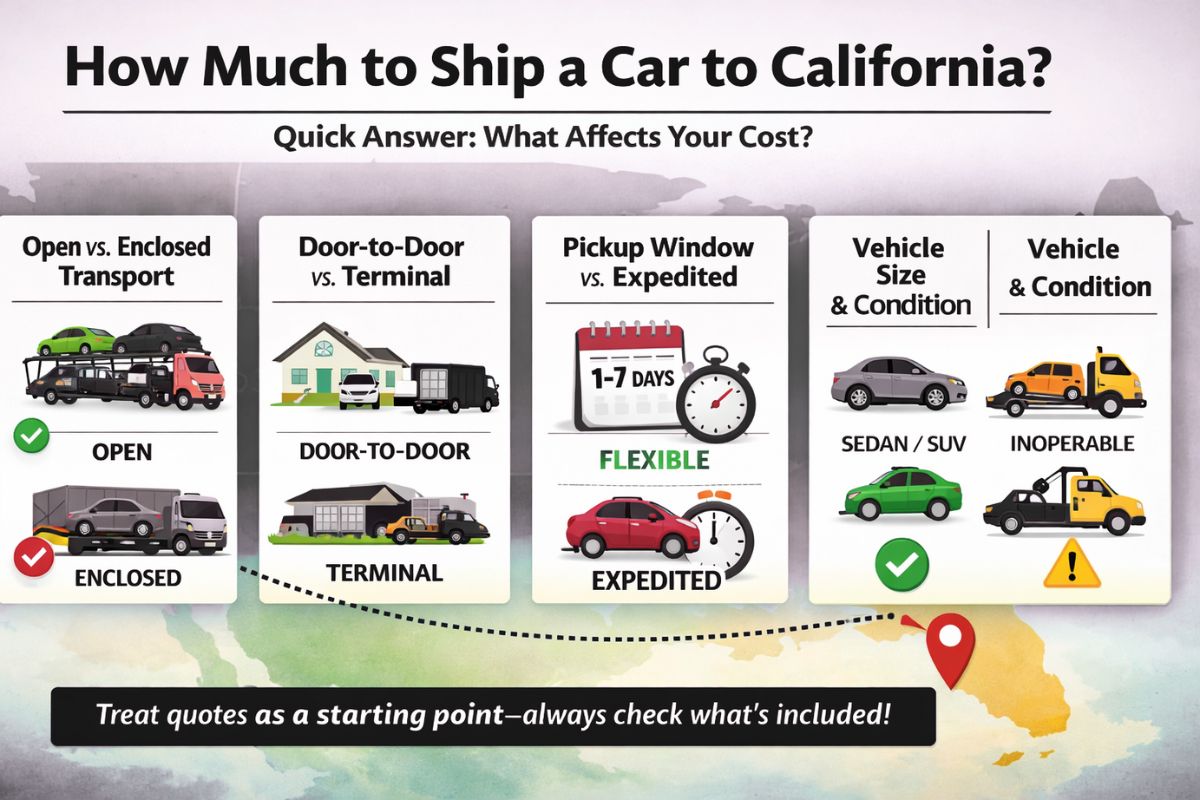
For a long-distance move (like Florida to California), you’ll usually land in a range that reflects:
- Open auto transport (most common) vs enclosed auto transport (more protection)
- Door-to-door vs meeting at a nearby terminal or easy-access location
- Flexible pickup window vs expedited shipping
- Vehicle size, condition (operable vs inoperable), and route demand
If you’re comparing quotes and asking “how much to ship a car to California,” treat the number as a starting point—then verify what it includes.
Why quotes vary (even when the offers look “the same”)
Broker vs carrier: who is actually moving your car?
One of the biggest reasons how much to ship a car to California varies is who you’re booking with:
- Broker: Arranges transport by finding a carrier in the market. Many online “car shipping companies” are brokers.
- Carrier: Owns the truck/trailer and physically moves the vehicle.
A broker can be legit and helpful—but the carrier is who shows up, loads your car, and handles the day-to-day reality. When the carrier changes, communication, scheduling, and risk can change too. That’s why reviews sometimes feel inconsistent: you’re judging the booking experience, not always the actual transport.
What to do: Ask for the carrier’s USDOT/MC details as soon as they’re assigned, and get it in writing.
Pickup window: the 1–7 day “game” that moves the price
That common 1–7 day pickup window is not random—it’s how many shipments get scheduled efficiently. A wider window gives the carrier flexibility to build a route, which can reduce the quote.
- More flexible window = easier to assign a driver = often lower cost
- Tight deadline / expedited = fewer options = often higher cost
If you need a specific date, expect how much to ship a car to California to increase. The key is making sure any “guarantee” is written (not a phone promise).
Open vs enclosed: cost vs protection
A major pricing lever is trailer type:
- Open carrier: Best value, most common. Expect the car to arrive dirty, exposed to weather and road debris.
- Enclosed carrier: More expensive, more protection from elements and debris, often preferred for classic cars, luxury cars, low-clearance vehicles, or fresh paint.
For most daily drivers, open transport is fine. But if the car is valuable or repairs would be expensive and slow, enclosed transport may be worth it—because when things go wrong, they can go very wrong.
Vehicle size and condition
Two cars on the same route can get different pricing because of:
- Vehicle size/weight: SUVs, trucks, oversized vehicles cost more (take more space/weight).
- Inoperable vehicles: Require special loading equipment and extra time.
- Low clearance/body kits: Increase loading risk and may require a different setup.
Pickup/delivery access and “door-to-door reality”
“Door-to-door” often means near your address, not always your exact driveway. Narrow streets, steep hills, HOA restrictions, or tight urban zones can force a nearby meeting point. If your pickup/delivery is difficult, how much to ship a car to California can rise (or scheduling can get delayed).
Seasonality and demand
Auto transport is supply-and-demand. Prices and availability fluctuate with:
- Peak moving seasons
- Snowbird patterns (seasonal migration)
- Regional demand spikes
- Fuel cost trends (often reflected indirectly in quotes)
The $815–$1,150 example: what that gap usually means
If you’re staring at two quotes and wondering how much to ship a car to California should be, don’t just compare the total. Compare the terms:
A lower quote often means:
- Larger pickup window
- Open transport
- Less “schedule control”
- More likelihood of reassignment delays
- Sometimes a quote that’s not fully “locked”
A higher quote often includes:
- Faster pickup commitment
- Better routing priority
- Enclosed option (or premium open service)
- More proactive coordination
- Clearer paperwork and expectations
The goal is not “pick the highest price.” The goal is: pay for clarity and reliability, not vague promises.
Red flags to avoid (these can cost you more than the quote)
1) “Fully insured” with no numbers
Saying “fully insured” is like saying “fully loaded.” It sounds good—but means nothing unless you see specific limits and how claims work.
Ask for:
- Cargo insurance limit (and whether it’s per vehicle or per load)
- Deductible (if any) and who pays it
- Claims process (timeline, required documentation, contact point)
Red flag: They dodge details or refuse to put coverage information in writing.
2) “If it’s not in writing, it doesn’t exist”
If your pickup window, delivery estimate, price, and trailer type aren’t written, you don’t actually have an agreement—you have a phone conversation.
Get written confirmation for:
- Total price (and what can change it)
- Pickup window and delivery estimate
- Open vs enclosed
- Pickup/delivery locations (and what happens if the truck can’t access your street)
3) Lowball quotes + last-minute “adjustments”
A classic trap is quoting low to win the booking, then raising the price when it’s time to assign a driver. Sometimes this happens because the original quote didn’t match market reality.
Red flag: Pressure to “book now” with an unusually low price and vague terms.
4) No accountability if damage happens
Some people report that when damage occurs, the trucking side can “go silent.” That’s why documentation is everything.
Protect yourself:
- Photos + video before pickup
- Condition notes on the Bill of Lading (BOL) at pickup and delivery
- Keep every message and email
Questions to ask before booking (copy/paste this)
If you want to know how much to ship a car to California without surprises, ask these:
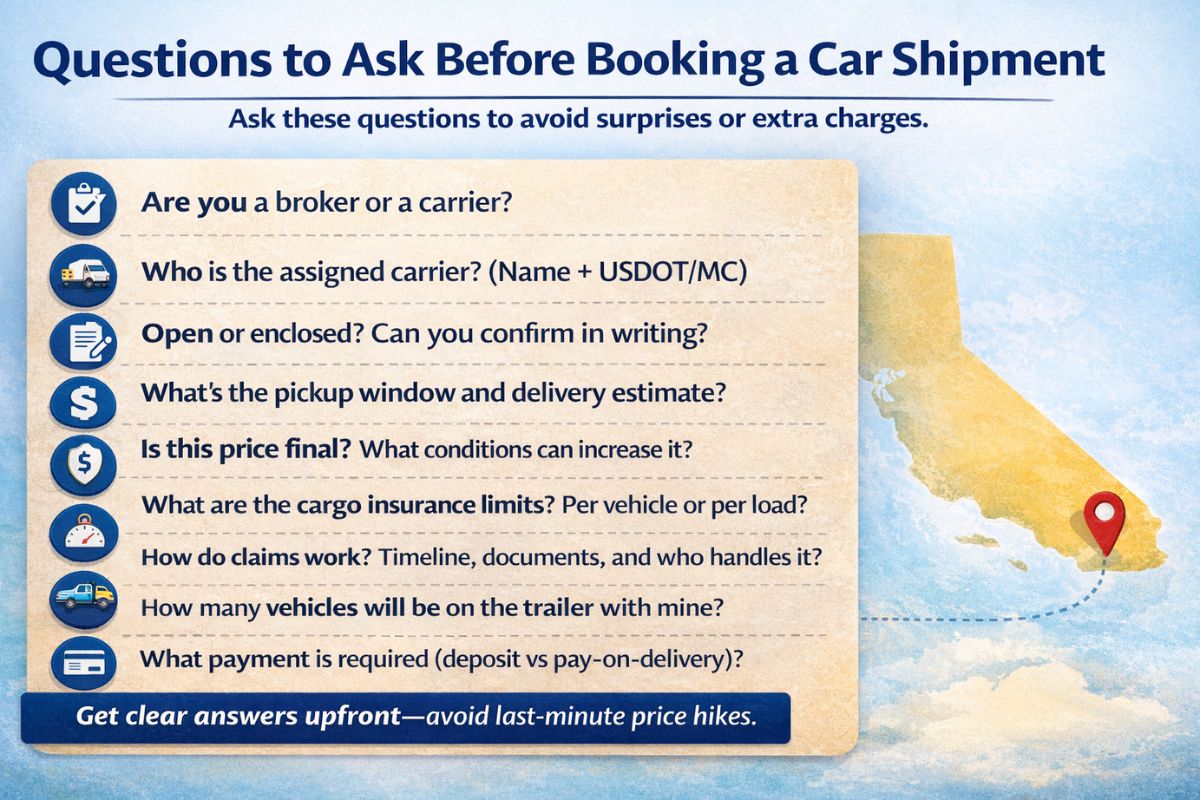
- Are you a broker or a carrier?
- Who is the assigned carrier? (Name + USDOT/MC)
- Open or enclosed? Can you confirm in writing?
- What’s the pickup window and delivery estimate? Put it in writing.
- Is this price final? What conditions can increase it?
- What are the cargo insurance limits? Per vehicle or per load?
- How do claims work? Timeline, documents, and who handles it?
- How many vehicles will be on the trailer with mine?
- What payment is required (deposit vs pay-on-delivery)?
- What happens if the truck can’t access my street?
The best companies won’t get offended by these questions. They’ll answer them clearly.
How to prep your car (so you don’t lose a claim)
Document condition like a pro
Before pickup:
- Take clear photos of every side, wheels, roof, hood, bumpers
- Record a short 360° video in good lighting
- Photograph existing scratches/dents up close
At pickup and delivery:
- Review the BOL/condition report carefully
- Note any new damage before signing at delivery
Check mileage (odometer)
Take a quick photo of the odometer before pickup and at delivery. It’s simple, and it prevents arguments.
Remove personal items
Most carriers won’t cover personal belongings. Remove valuables and loose items.
Consider a tracker (optional)
Some shippers use a tracker for peace of mind. It can reduce anxiety and help confirm location updates—especially on a cross-country route.
Open vs enclosed: is enclosed the “only” safe option?
Not always. For many standard vehicles, open transport is reasonable. But enclosed is often worth it when:
- The car is high-value or rare
- Repairs/parts would be expensive or slow
- The vehicle has low clearance or special bodywork
- You want extra protection from weather and road debris
A helpful way to decide:
- If cosmetic condition matters a lot and the downside is big, lean enclosed.
- If it’s a normal daily driver and you accept some dirt risk, open is usually fine.
Estimated costs and timelines
| Factor | What changes | Typical effect on cost |
|---|---|---|
| Pickup window | Flexible vs specific date | Flexible usually lowers cost |
| Trailer type | Open vs enclosed | Enclosed costs more |
| Route demand | High-demand lanes vs slow markets | High demand can raise cost |
| Vehicle size | Sedan vs SUV/truck | Larger vehicles cost more |
| Vehicle condition | Operable vs inoperable | Inoperable costs more |
| Access | Easy loading vs difficult streets | Difficult access can raise cost |
| Timing | Peak season vs off-peak | Peak season often costs more |
| Service level | Pickup expectation | Transit expectation | Best for |
|---|---|---|---|
| Standard (flexible) | 1–7 day window | Varies by route | Best value |
| Expedited | Tighter scheduling | Faster dispatch priority | Tight deadlines |
| Enclosed | Depends on availability | Varies by route | High-value vehicles |
FAQ: How much to ship a car to California?
How much to ship a car to California on open transport?
Open transport is usually the most affordable option. Your exact price depends on route, timing, and vehicle size.
Why do quotes for how much to ship a car to California vary so much?
Because trailer type, pickup flexibility, broker vs carrier, vehicle size, and market demand change the real cost.
Is $815–$1,150 realistic for Florida to California?
It can be, especially with flexible scheduling and open transport—but only if the terms are clear and in writing.
What does “fully insured” mean in car shipping?
By itself, nothing useful. You need coverage limits, deductible info, and a written claims process.
Should I pay more to avoid problems?
Paying more can buy schedule priority, better service, or enclosed protection—but the biggest win is clarity: written terms, real insurance details, and a trustworthy carrier.
What’s the cost to ship car to California?
Most quotes depend on distance, open vs enclosed transport, pickup flexibility, vehicle size/condition, and route demand—so always confirm what’s included in writing.
Final takeaway
If you’re asking how much to ship a car to California, don’t choose based on price alone. Choose based on what’s written, who’s actually transporting the vehicle, and whether insurance is real—not just marketing.
The best quote is the one that stays the same on pickup day and comes with a clear process if anything goes wrong.