
Key Takeaways
Are those quotes ($815–$1,150) normal for this route?
Yes—those ranges can be realistic depending on pickup window, season, and trailer type. Lower quotes often mean less schedule control, while higher quotes can reduce delays or add priority pickup.
What’s the fastest way to avoid “surprise” price changes?
Get everything in writing: total price, pickup window, delivery estimate, and what “expedited” actually changes. If it’s not written and confirmed, assume it can change later.
Should I choose a broker or a carrier?
Many online companies are brokers who match you with a carrier. Brokers can be fine, but ask for the actual carrier’s DOT/MC, insurance proof, and who handles claims if damage happens.
Is enclosed transport the only “safe” option?
Not always. Open transport is usually fine for normal cars, but it can arrive dirty and has higher exposure risk. Enclosed makes more sense for high-value, rare, or delicate vehicles.
What does “fully insured” really mean?
It’s vague marketing. Ask for the coverage limit per vehicle, deductible, what damages are excluded, and the exact claim process. Request proof of insurance from the actual carrier.
What should I do before pickup day to protect myself?
Take lots of photos and video, record odometer mileage, remove personal items, and confirm the inspection paperwork (BOL/condition report). These steps make claims and disputes much easier.
What should I check at delivery?
Inspect in good light before signing, compare against your pickup photos, confirm mileage, and note any issues on the delivery paperwork immediately. Don’t rely on “I’ll email it later.”
Can I track the shipment during Florida to California Car Shipping?
Sometimes. Many carriers provide updates by phone or text, and some people add a discreet tracker for peace of mind. Ask what tracking or update cadence is included before booking.
Table of Contents
Table of Contents
Booking Florida to California car shipping is easy to start and surprisingly easy to get wrong. Most quotes look identical, most promises sound reassuring, and then the “small print” shows up: vague pickup windows, unclear insurance, and last-minute price shifts.
This guide turns real-world advice (photos, mileage, “get it in writing,” and “fully insured” being a meaningless phrase) into a clean process you can follow—so you get a fair price and a smooth pickup and delivery.
How much does Florida to California car shipping cost—and why do quotes vary so much?
Most price swings on this lane (e.g., Miami/Fort Lauderdale → Santa Monica/Los Angeles) come from carrier capacity, weekly demand on major corridors like I-10, vehicle size class (sedan vs SUV/truck), and how flexible your pickup window is—not just miles.
Answer: Most quotes land between about $800 and $1,200 for open transport, but your exact price depends on pickup flexibility, vehicle size, and how busy the route is that week.
Want the bigger picture on California lanes, options, and what changes the rate? See our ➡️ California car shipping guide.
What usually moves the price (and the surprises)
- Pickup window: A 1–7 day window is cheaper because it gives the carrier room to build a route.
- Vehicle size/weight: SUVs, trucks, and oversized vehicles reduce capacity and raise cost.
- Open vs enclosed: Enclosed is typically more expensive due to capacity and protection.
- Season + demand spikes: Holidays, snowbird season, and end-of-month moves raise demand.
- Door-to-door vs terminal/meet-up: Convenience can cost more (but saves schedule stress).
- “Expedited” services: Sometimes it means real priority; sometimes it’s marketing unless defined in writing.
Quick tip for comparing quotes (without getting played)
Compare three numbers, not one:
- Total price (all-in)
- Pickup window (guaranteed vs estimated)
- What happens if a carrier isn’t assigned on time (re-quote? wait? refund?)
Why can two quotes for the same route be hundreds of dollars apart?
Because pricing depends on pickup flexibility, week-to-week demand, vehicle size, and carrier availability—not just mileage.
Does “expedited shipping” always guarantee faster pickup?
Not always. It only matters if the exact pickup commitment is written down. Otherwise, “expedited” can be a vague upsell with no real timeline.
What should I compare besides price?
Compare the pickup window, delivery estimate, payment terms, and what happens if a truck isn’t assigned on time (re-quote, wait, refund, or reschedule).
Are you booking with a broker or a carrier—and why does it change everything?
A broker is a logistics matchmaker, while a carrier is the DOT-authorized company that owns the truck and driver—so your experience depends on which one you’re actually dealing with and how fast the real carrier is assigned (with USDOT/MC you can verify via FMCSA SAFER).
Simple definitions
- Broker: Finds a carrier for you (often later), coordinating pricing and dispatch.
- Carrier: Owns/operates trucks and drivers and is responsible for transport execution.
What the Reddit-style advice gets right
- Reviews can reflect the broker’s customer service, not the carrier’s handling.
- If the job is “bid down,” you risk delays, last-minute price changes, and weaker driver coordination.
What to request (non-negotiable)
- Carrier name + USDOT/MC (as soon as assigned)
- Confirmation of who handles claims (broker, carrier, or both)
- A clear update method (text/call cadence)
You can verify a carrier’s identity via FMCSA’s SAFER Company Snapshot search. (safer.fmcsa.dot.gov)
How do I tell if I’m dealing with a broker or a carrier?
Ask directly and get the answer in writing. Carriers operate the trucks; brokers arrange the shipment and assign a carrier later.
Is using a broker automatically bad?
No. It just means you must lock down terms, communication, and the claim responsibility early, because the broker may not control the driver’s schedule.
When should I get the real carrier’s DOT/MC info?
As soon as the load is dispatched/assigned. If they refuse to share it, treat that as a serious red flag.
What does “fully insured” mean—and what should you ask for instead?
“Fully insured” is a sales phrase until it’s tied to the carrier’s legal name and documents—so replace it with specifics: the carrier’s Certificate of Insurance (COI), cargo coverage limit per vehicle, deductible, exclusions, and a written claims workflow that references the Bill of Lading (BOL) condition report.
Answer: “Fully insured” is vague. Ask for the carrier’s insurance details: the cargo coverage limit per vehicle, the deductible, what’s excluded, and how to file a claim using the Bill of Lading inspection report.
Ask these questions (copy/paste)
- What is the cargo coverage limit per vehicle?
- What is the deductible (if any)?
- What damage types are excluded (chips, scratches, roof dents, weather, etc.)?
- What is the exact claim process and timeline?
- Can you send proof of insurance filings for the assigned carrier?
Quick facts (with sources)
FMCSA requires property brokers to maintain $75,000 in financial security (BMC-84 bond or BMC-85 trust). (fmcsa.dot.gov)
Federal minimum public liability for for-hire interstate motor carriers hauling non-hazardous property is $750,000. (ecfr.gov)
If a broker’s financial security falls below $75,000 and isn’t replenished promptly, FMCSA can suspend the broker’s authority (compliance rules explain timing and enforcement). (fmcsa.dot.gov)
Where to verify legitimacy (quick path)
- FMCSA SAFER for company snapshot (identity/search). (safer.fmcsa.dot.gov)
- FMCSA Licensing & Insurance database to view insurance filings (when available). (li-public.fmcsa.dot.gov)
What proof of insurance should I request?
Request the carrier’s Certificate of Insurance (COI) and confirm cargo coverage limit per vehicle, deductible, exclusions, and claim instructions.
Does insurance cover every scratch or cosmetic issue?
Often not. Some policies exclude minor cosmetic damage. That’s why pickup photos and the Bill of Lading condition report matter so much.
What if the company disappears after damage?
That’s why you confirm, before booking, who handles claims, how they’re filed, required evidence, and timelines—then keep everything documented.
Should you choose open or enclosed transport for this route?
Think of it as risk management: open transport is the standard multi-car trailer used by most carriers (often best value), while enclosed transport (brands like Intercity Lines operate in this space) reduces exposure to road debris and weather—especially relevant for luxury, classic, or show-condition vehicles.
Answer: Enclosed is worth it if your car is high-value, rare, or has flawless paint. For most daily drivers, open transport is fine—just expect the car to arrive dirty and exposed to road debris.
The honest tradeoff (based on real experiences)
- Open: more exposure → dirt + higher cosmetic risk
- Enclosed: more protection → higher cost, better peace of mind
- Many people “pay a little more” for enclosed when the car is rare, high-value, or hard to repair.
Table 1 — Open vs Enclosed vs Terminal/Meet-up
| Option | Best for | Pros | Cons |
|---|---|---|---|
| Open (most common) | Daily drivers, normal cars | Lowest cost, easiest to schedule | Car arrives dirty; more exposure risk |
| Enclosed | Luxury/classic/rare, perfect paint | Best protection; usually smoother handling | Higher price; fewer trucks available |
| Terminal/Meet-up | Tight schedules, hard addresses | More predictable handoff; may speed pickup | Less convenient; may add travel on your side |
When is open transport “good enough”?
For most daily drivers, open is the best value—if you’re okay with the car arriving very dirty and accept a small but real risk of cosmetic exposure.
When is enclosed transport worth it?
When paint/condition matters, the vehicle is rare or high-value, or repairs would be expensive and slow due to parts availability.
Does enclosed reduce delays too?
It can, because enclosed carriers often run tighter schedules—but it’s not a guarantee. Written pickup terms and a reliable carrier matter most.
What should be in writing before you pay a deposit?
Before any deposit, treat your booking like a mini contract: total price, defined pickup window, delivery estimate, trailer type (open/enclosed), and cancellation terms—because “expedited” and “door-to-door” mean different things depending on the broker/carrier’s written policy and dispatch rules.
Answer: Get the total price and the pickup window in writing before you pay. Also confirm whether you’re using a broker or a carrier, and ask what happens if pickup is delayed.
If you want a full step-by-step overview of the entire process, read our ➡️ Car Shipping to and from California guide.
Put these items in writing (minimum checklist)
- All-in price (including fuel, fees, and “expedited” add-ons)
- Pickup window (dates, not vague language)
- Delivery estimate (and what counts as delay)
- Trailer type (open/enclosed) + service type (door-to-door/meet-up/terminal)
- Deposit amount + refund/cancellation rules
- Assigned carrier details once dispatched (name + DOT/MC)
Common “word tricks” to clarify
- “Estimated” vs “Guaranteed”
- “Dispatch in 24 hours” vs “Pickup in 24 hours”
- “Fully insured” vs “Cargo limit per vehicle is $____ with deductible $____”
What must be written down before I pay anything?
All-in price, pickup window dates, delivery estimate, trailer type, cancellation/refund terms, and what “expedited” actually changes.
Is a deposit always required?
No. Policies vary. The key is knowing when it’s charged, whether it’s refundable, and what conditions cause you to lose it.
What wording should I watch for in the fine print?
Vague terms like “estimated,” “dispatch in 24 hours,” or “subject to change” without clear definitions—especially around pickup timing and pricing.
What should you do 48 hours before pickup to protect yourself?
Use a simple documentation stack: time-stamped photos/video, odometer photo, and a clean checklist of what’s in the car—then confirm the pickup plan by text/email so it aligns with the driver’s BOL condition inspection, not just a call-center promise.
Pre-pickup checklist (do this, even if you trust the company)
- Take photos + video: all sides, roof, bumpers, wheels, interior, existing scratches
- Record the odometer mileage
- Remove personal items (insurance often won’t cover them)
- Leave ¼ tank of fuel (enough to load/unload)
- Disable alarms; secure loose accessories
- Confirm driver contact + pickup plan (day-of communication)
Optional: tracker for peace of mind
Some shippers add a discreet tracker so they can confirm location and mileage patterns—helpful when you want reassurance without relying solely on updates.
Do I really need photos if the carrier does an inspection?
Yes. Your own time-stamped photos/video are your strongest proof if the delivery condition doesn’t match pickup notes.
Should I leave personal items in the car?
Avoid it. Many carriers and insurance policies exclude personal belongings, and extra weight can create loading issues or disputes.
Is a GPS tracker a good idea?
It can be. A tracker adds peace of mind and helps confirm location, but you should still rely on paperwork and documented updates—not tracking alone.
What happens on pickup day—and how does the Bill of Lading protect you?
Pickup day is a paperwork event as much as a loading event: the driver’s Bill of Lading (BOL) (also called a condition report) becomes the official baseline for delivery inspection and claims—so the notes on dents/scratches matter more than any “don’t worry” reassurance.
Pickup-day “do not skip” steps
- Meet in good light if possible
- Walk around the vehicle with the driver
- Ensure pre-existing marks are noted (circles/notes)
- Confirm odometer reading is recorded (or you keep a photo proof)
- Get a copy/photo of the signed pickup paperwork
What to do if the driver is rushing you
Slow it down politely. A 3-minute inspection can save you a weeks-long argument.
What exactly is the Bill of Lading (BOL)?
It’s the official condition report and transport receipt used at pickup and delivery. Claims often hinge on what’s written on this document.
What if the driver marks damage that isn’t there (or misses damage that is)?
Correct it before signing. Walk around together, compare with your photos, and ensure notes match reality.
Can I release the car to someone else for pickup?
Yes, but set it up in advance. Provide the carrier with the contact’s name, phone number, and authorization to sign pickup paperwork.
What should you check at delivery before signing anything?
Delivery is where disputes are won or lost: inspect in good light, compare to your pickup photos, confirm odometer, and record any new issues directly on the delivery BOL—because once you sign “clean,” the carrier’s claims process often gets harder and slower.
Delivery checklist (fast but thorough)
- Compare same angles as your pickup photos
- Look at high-risk areas: roof, hood, bumpers, mirrors, wheels
- Confirm mileage hasn’t jumped unexpectedly
- Note issues on the paperwork immediately
- Take new photos/video before the truck leaves
If you spot damage
Don’t panic, but don’t “handle it later” verbally. Document it on the BOL and follow the claim instructions you requested earlier.
Should I sign first and inspect later if I’m in a hurry?
No. Inspect first. Once you sign “clean,” it can be much harder to prove damage happened during transport.
What’s the fastest way to inspect properly?
Match the same angles as your pickup photos, check roof/hood/bumpers, confirm mileage, and take fresh photos before the truck leaves.
What if delivery happens at night?
Ask to move to a well-lit spot or use strong lighting. If you can’t inspect properly, note that on the paperwork before signing.
What red flags should make you walk away immediately?
Walk away if they won’t provide verifiable identity and terms: no clear broker/carrier disclosure, refusal to share the carrier’s USDOT/MC, vague “fully insured” language without a COI, or pressure to pay before confirming written pickup dates and claim steps.
Red flags list (based on the discussion themes)
- “Fully insured” but they won’t share limits/deductible
- Deposit required with no written confirmation of price + pickup window
- No clarity on broker vs carrier
- No carrier assignment details (DOT/MC) when dispatch happens
- “We can’t send paperwork until after pickup”
- Reviews mentioning ghosting after damage
What’s the biggest “scam-like” warning sign?
Refusing to provide clear insurance limits, claim steps, or carrier identity—while pressuring you to pay a deposit quickly.
Are super-low quotes always a problem?
Not always, but they’re riskier. Extremely low prices often lead to re-quotes, long waits, or being bumped by higher-paying loads.
Why do some reviews feel misleading?
Because reviews may describe the broker’s service, not the carrier’s handling. Your goal is to evaluate the actual carrier once assigned.
What questions should you ask—and what do good answers look like?
Use a short “carrier-grade” script: ask if they’re broker or carrier, request the cargo limit per vehicle, and confirm how dispatch works (assignment timing + driver contact). Strong operators answer with numbers, documents, and process—not generic reassurance.
Table 2 — The “Good Answer vs Red Flag” script
| Question to ask | Good answer sounds like | Red flag sounds like |
|---|---|---|
| Are you a broker or carrier? | “We’re a broker/carrier; here’s how it works.” | “We handle everything” (no details) |
| What’s the all-in price? | “$___ total, no extra fees unless ___.” | “It depends later” |
| What’s the cargo limit per vehicle? | “$___ limit, $___ deductible, here’s proof.” | “Fully insured” only |
| Who is the assigned carrier? | “Carrier name + DOT/MC once dispatched.” | “We don’t share that” |
| What if pickup is late? | “Here’s the process + options.” | “It’ll be fine” |
What’s the one question that filters out weak companies fast?
“Are you a broker or carrier, and what are the cargo insurance limits per vehicle?” Good companies answer with specifics and documents.
How should a company explain delays?
They should explain the cause, the new timeline, and your options—without vague excuses or avoiding written updates.
What’s a healthy communication cadence?
At minimum: pickup confirmation, dispatch confirmation, and delivery ETA updates. If they can’t define updates, expect confusion later.
Final checklist: can you book Florida to California car shipping with confidence?
If you can validate the carrier in FMCSA SAFER, document condition for the BOL, and lock price + pickup window in writing, you’ve removed the most common failure points that cause surprises—especially on busy lanes into Los Angeles/Santa Monica.
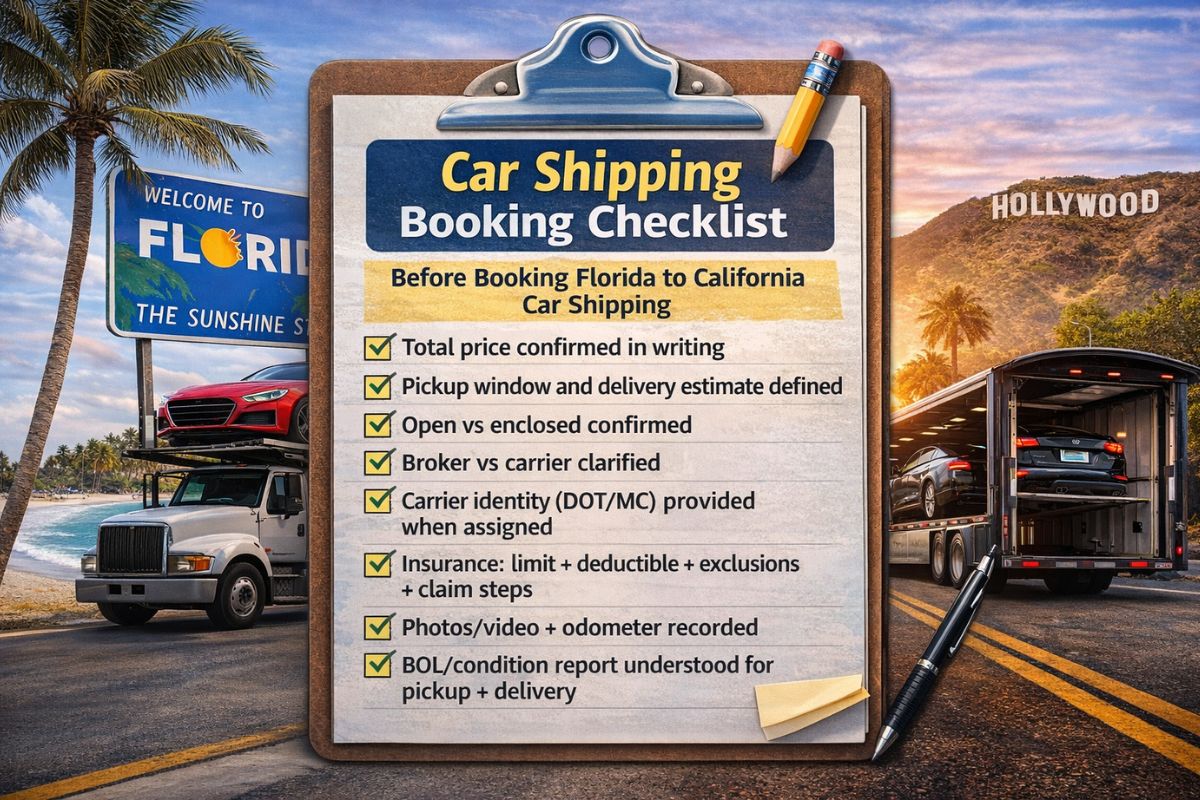
Copy/paste booking checklist
- Total price confirmed in writing
- Pickup window and delivery estimate defined
- Open vs enclosed confirmed
- Broker vs carrier clarified
- Carrier identity (DOT/MC) provided when assigned
- Insurance: limit + deductible + exclusions + claim steps
- Photos/video + odometer recorded
- BOL/condition report understood for pickup + delivery