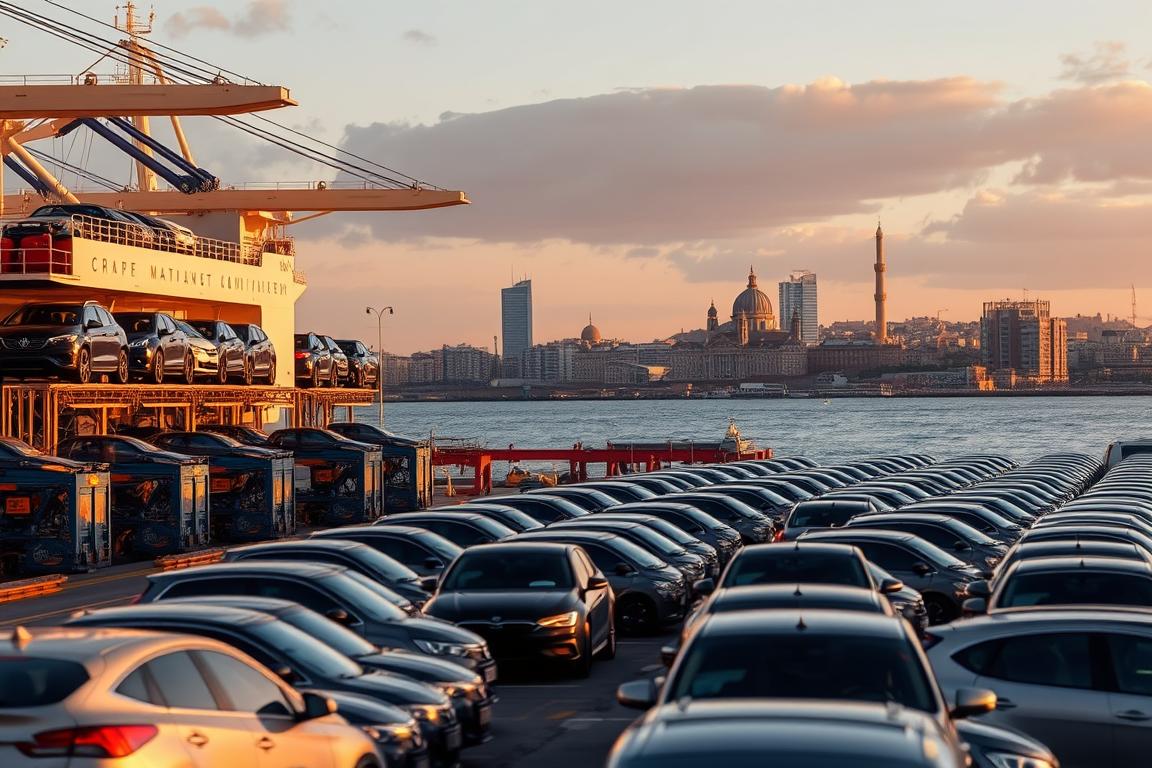

Car shipping to europe can feel overwhelming when you plan an overseas move. You likely worry about cost, customs, and whether your vehicle will arrive safe and on schedule.
We guide you through each step so you can book with confidence and avoid common surprises.
This short guide explains pragmatic planning, realistic pricing, and insurance choices that protect your investment.
You will learn how container options, RoRo, and air freight compare, which ports most U.S. owners use, and what paperwork clears export and import quickly.
Expect clear checklists and practical tips that save money while keeping your vehicle secure from pickup through delivery.
Summary
Table of Contents
Car shipping to Europe made simple for U.S. owners

Moving a vehicle across the Atlantic is smoother when you know the step-by-step process and what a reliable provider will disclose up front.
What to expect: A straightforward process usually starts with a quote and booking, followed by handoff at a U.S. port or warehouse, export clearance, ocean transit, and import clearance before pickup or delivery in your destination country.
Typical rates: Average starting ocean rate is around $850 per unit in a shared container. That excludes destination fees, duties, and taxes. Consolidated containers can lower your outlay but add consolidation windows. Exclusive containers depart sooner and give you full control.
- Ask for a written estimate that separates ocean rates from destination fees and taxes.
- Compare consolidated, exclusive, RoRo, and air options by arrival time and overall cost.
- Confirm origin options, arrival ports, and whether destination agents handle import clearance and delivery.
- Request proof of license, bond, and insurance and clear answers on claims handling.
- For a firm quote today, provide year/make/model, dimensions, pickup ZIP or drop-off port, and preferred arrival port.
We answer your questions quickly and explain tradeoffs so you can ship car from the car usa to car europe with confidence. Choosing a trusted partner gives you peace of mind and a clear timeline for the entire journey.
Vehicle shipping methods and when to use each option

How you move a vehicle overseas depends on value, timing, and how much protection you need. Below are common methods, when each fits, and key tradeoffs so you can choose with confidence.
Container shipping: added protection and flexibility
Container shipping is the most common option for Europe. It offers strong protection and lets you pack approved personal goods with your vehicle.
All-risk insurance is available for container loads. Consolidation can lower costs, while exclusive containers speed departure and give full control.
Shared container vs exclusive container
A shared container (consolidated) is budget-friendly. You pay for the space you use but may wait for consolidation windows.
Choose an exclusive container when you need quicker departures, room for multiple vehicles, or household goods.
RoRo and air freight options
RoRo (roll-on/roll-off) is cost-effective on popular routes. Vehicles are driven on and off the vessel and are more exposed, with limited insurance choices.
Air freight is the premium option for rare, high-value vehicles or tight deadlines. Expect a 2–3 week door-to-door timeline.
- Ask for exact dimensions and weight before booking.
- Compare total cost, including inland moves and destination handling.
- Match method to your schedule and risk tolerance.
| Method | Best for | Protection | Typical timeline |
|---|---|---|---|
| Container (shared) | Budget-minded shippers with flexibility | All-risk available | Variable (consolidation windows) |
| Container (exclusive) | Fast departure, multiple vehicles or goods | All-risk available | Faster departures |
| RoRo | Low cost on high-frequency lanes | Limited coverage | Standard ocean transit |
| Air freight | High-value or urgent moves | Comprehensive, premium | ~2–3 weeks door-to-door |
Costs, rates, and fees: how pricing is calculated

A clear look at rates and fees gives you control over your final bill. Below is a straightforward breakdown of typical starting prices and what moves the needle on total cost.
Typical starting ocean rate: Expect baseline ocean freight from about $850 per unit in a shared container. This figure excludes destination fees, duties, and taxes. Final costs change with route, vehicle size, and timing.
The biggest cost drivers are simple. Size and weight matter. Your U.S. origin and the destination port affect transit and handling. The chosen method—shared container, exclusive container, or RoRo—changes both price and protection.
- Ocean rates + destination fees + possible duties and taxes = total bill.
- High-volume ports like Bremerhaven, Antwerp, and Rotterdam often yield lower container costs.
- Consolidation in a shared container cuts rates but may add transit days; exclusive containers cost more but depart faster.
| Cost element | Typical impact | How to manage |
|---|---|---|
| Ocean freight | Base charge (~$850 shared) | Compare base ports and sailings |
| Destination fees | Port handling, docs | Ask for itemized list |
| Duties & taxes | Country-dependent | Check local import rules early |
| Inland trucking | Variable both sides | Bundle pickup or use nearby base port |
Quick tips: Request a written, itemized quote that separates ocean, fees, and taxes. Be flexible on dates or ports to unlock better rates. If time is tight, weigh paying more for an exclusive container or alternate port to reduce total transit risk.
Major European ports and inland delivery coverage

Choosing the right arrival hub makes a big difference in cost, transit time, and final-mile ease.
Recommended base ports: Bremerhaven, Antwerp, and Rotterdam offer strong schedules, high volume, and competitive container rates when you ship car europe. These ports give frequent sailings and straightforward customs handling.
Other high-volume options include Le Havre, Felixstowe, Gothenburg, Barcelona, Genoa, Marseille, Dublin, Aarhus, and Oslo. Each gives you alternate arrival windows and local carrier choices.
For inland countries such as Switzerland, Austria, the Czech Republic, and Hungary, we route via a nearby base port and arrange efficient inland delivery. Destination agents clear import formalities at the entry port and coordinate final-mile transport.
“Our team matches the best port and route to your timeline and budget for a smooth destination delivery.”
| Port | Region served | Strength | Best for |
|---|---|---|---|
| Bremerhaven | Central EU, DACH | High volume, low container rates | Switzerland, Austria, Czech Republic |
| Antwerp | Benelux, N. Europe | Frequent sailings, fast customs | Belgium, Netherlands, inland EU |
| Rotterdam | Pan-European | Large carrier network | Heavy loads, flexible schedules |
Door-to-door offers convenience and less legwork. Port pickup can lower costs if you prefer self-collection. Share your destination city and timeline and we’ll propose the most cost-effective route for your vehicles.
Documentation, customs, and compliance requirements

Start with the right paperwork and you’ll avoid most hold-ups at the port and customs. Gather core documents early so destination agents can clear import formalities fast.
Core export documents
Collect these before drop-off: the original title, a bill of sale (if ownership is under six months), a valid passport or ID, and a power of attorney when a port requires one.
These documents let agents file export and import paperwork and return stamped forms at release.
Temporary import and travel papers
Most rules allow U.S.-plated vehicles for up to six months without formal import. Students or professionals may get longer allowances—confirm with the local authority.
Carry a valid U.S. license and an International Driver’s Permit (IDP) from AAA or AATA. Also verify that your insurance covers every country you plan to visit and request written proof if possible.
Fuel, safety and long-term conversions
Follow port safety rules: keep fuel under one-quarter tank and remove hazardous items. Terminals also require basic safety checks before loading into a container.
For long-term registration, expect conversions like odometer units, lighting, and emissions updates. Vehicles over 25 years may qualify for exemptions in some countries.
- Expect no duties for stays under six months in many cases; longer imports may trigger duties and taxes.
- Keep all stamped import documentation safe for registration or re-export later.
“Organize your documents early and your vehicle clears faster at every checkpoint.”
Protection and coverage for your shipment

A clear policy and documented condition report are the best safeguards before ocean freight.
All-risk insurance is commonly available for container moves and can cover damage during loading, sailing, and unloading. Choose this when you want the broadest protection for your vehicle and approved personal goods.
RoRo limits: Roll-on/roll-off services often offer more limited coverage. If your route requires RoRo, read the policy carefully so you know what is and isn’t covered.
Key steps to protect your vehicle
- Ask for declared value guidelines and deductible options to balance premium and protection.
- Document condition with photos and condition reports at drop-off; these support claims.
- Confirm whether accessories and approved personal goods are included or excluded.
- Know common exclusions: pre-existing damage, minor wear, and force majeure events.
- For high-value vehicles, request specialized policies or additional riders.
“Clear policy terms, precise documentation, and a responsive claims process create real peace of mind.”
| Cover type | Container | RoRo | When to use |
|---|---|---|---|
| All-risk available | Yes | Rare/limited | Choose container for max protection |
| Declared value options | Flexible | Often restricted | Consider higher limits for valuable vehicles |
| Claims support (photos/reports) | Standard | Variable | Document condition at drop-off either way |
We will explain coverage options and help you pick the right level of protection for your route and service. If protection is a priority, consider switching to a container option when possible.
The end-to-end process and timelines
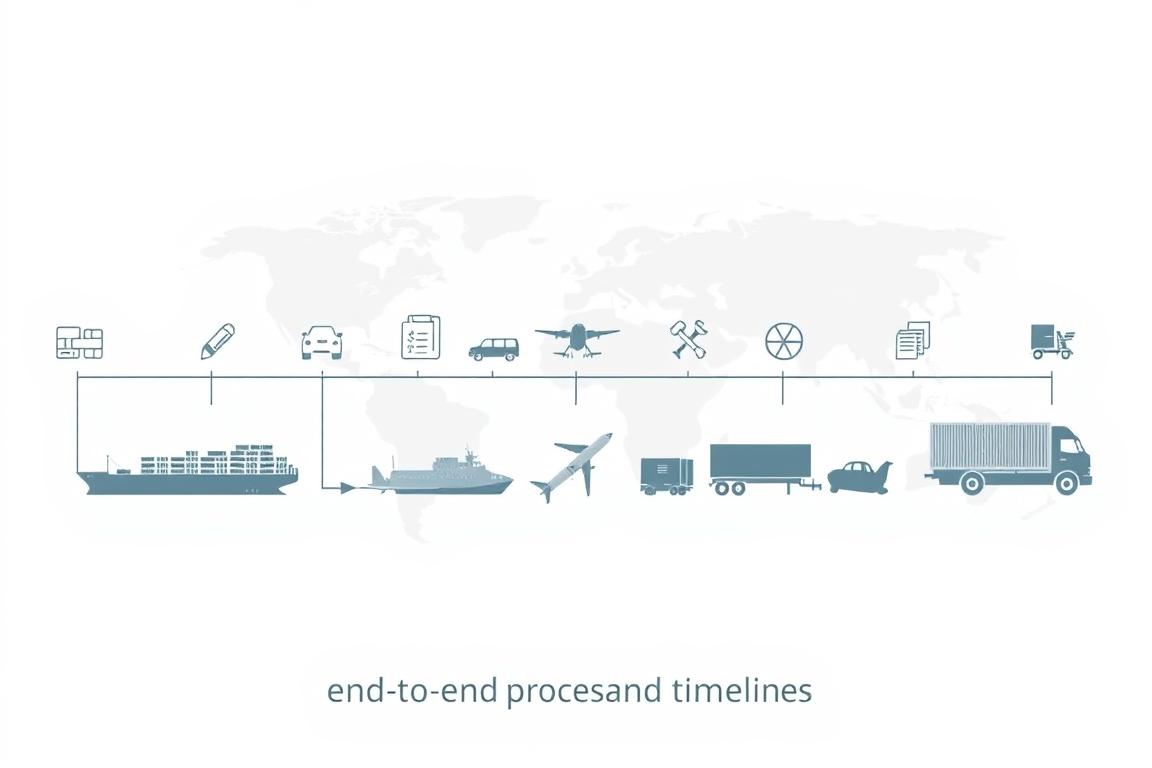
A clear timeline makes the entire transport run smoother and reduces last‑minute surprises. Plan early and allow time for booking, documentation, and carrier availability so your vehicle moves steadily from pickup to handover.
Planning ahead: booking and consolidation windows
Start several weeks before your preferred departure. Shared containers rely on consolidation windows that can add days. Exclusive options skip consolidation and usually depart sooner.
Air vs. ocean timelines
Air freight is fastest: expect about two to three weeks door‑to‑door for urgent or high‑value loads. Ocean transit varies by origin and port and depends on consolidation and sailing schedules.
What destination agents handle
Your local agent manages import clearance, unloading, and pickup or final delivery appointments. They also coordinate inspections and help resolve customs queries so you face fewer surprises.
“Plan early, keep paperwork ready, and build a small buffer for customs or peak‑season delays.”
- Schedule inland transport early to match ETA and avoid terminal storage fees.
- Keep copies of documentation and respond quickly to agent requests.
- We coordinate milestones and keep you updated from car usa origin through final handover.
Get started: request a quote and ship your car to Europe with confidence
Start by sending your vehicle year, make, model, and exact dimensions. Add your U.S. pickup or drop-off port and the preferred method—shared container, exclusive container, RoRo, or air. Include the destination city or port and your ideal timeline.
We will:
- Match you to the next consolidation or an earlier exclusive sailing.
- Provide an itemized estimate that separates ocean freight, destination fees, and optional insurance.
- Price both door-to-door service and port pickup so you can choose the best cost and convenience trade-off.
- Confirm required documents now so you avoid last-minute holds at release.
If you’re unsure which method fits, we’ll compare options and recommend the best route for your budget and schedule. Our destination agents handle import clearance and coordinate final delivery, so your vehicles arrive ready for use.
| What you provide | What we return | Why it matters |
|---|---|---|
| Year / Make / Model / Dimensions | Accurate space and weight pricing | Prevents surprises and extra fees |
| Preferred method & timeline | Matched sailings and cost comparison | Finds the right balance of speed and cost |
| Destination city / port | Clearing agent and delivery plan | Simplifies customs and final-mile logistics |
“Send us your questions anytime; we reply fast so you can make informed decisions without guesswork.”
Conclusion
A clear wrap-up helps you pick the right route and avoid surprises at arrival. ,
Quick reminders: Base ports like Bremerhaven, Antwerp, and Rotterdam usually offer the best container rates and steady schedules. Expect baseline ocean rates from about $850 in shared containers; ask for an itemized quote that separates ocean charges, destination fees, and any duties or taxes.
Prepare documents early and confirm country requirements so customs clearance and handoff run smoothly. Choose the right method—shared or exclusive container, RoRo, or air—based on timing, budget, and protection needs.
We stand ready to help you plan, quote, and manage the entire vehicle shipping process for a low‑stress, reliable experience.
FAQ
What methods are available for transporting a vehicle from the U.S. to Europe?
You can choose container shipping (shared or exclusive), RoRo (roll-on/roll-off), or air freight. Containers give extra protection and let you load personal goods. Shared containers lower costs by splitting space, while exclusive containers give faster sailings and full control. RoRo is often the most budget-friendly for compatible vehicles. Air freight is the fastest and best for high-value or time‑sensitive vehicles.
How do I decide between a shared container and an exclusive container?
Pick a shared container to reduce the base freight cost if you can accept slightly longer consolidation windows. Choose an exclusive container if you want faster departure, guaranteed space, and privacy for personal items. Consider the value of convenience and timing when comparing both options.
What typical transit time should I expect for ocean and air transport?
Ocean transit varies by route and port but generally ranges from a few weeks to a month or more, including consolidation. Air freight can shorten total time to roughly two to three weeks door‑to‑door, depending on schedules and customs clearance. Planning ahead improves timing and availability.
What are the main cost drivers for U.S.-to-Europe vehicle transport?
Price depends on vehicle size, origin port, destination country and port, transport method (RoRo, container, air), carrier schedules, and applicable duties and destination fees. Additional services like door‑to‑door delivery or inland transport increase the total. Ask for a firm quote that lists all fees to compare accurately.
Which European ports do you recommend for receiving vehicles?
Recommended base ports with high volume and reliable service include Bremerhaven, Antwerp, and Rotterdam. Other high-volume options are Le Havre, Felixstowe, Gothenburg, Barcelona, Genoa, Marseille, Dublin, Aarhus, and Oslo. Your best port depends on final delivery location and customs efficiency.
Can you deliver inland if my final destination is in Switzerland, Austria, or central Europe?
Yes. Many services offer inland delivery and door‑to‑door options from major ports to countries like Switzerland, Austria, Czechia, and Hungary. You can also arrange port pickup if you prefer. Shipping to inland destinations adds transit time and inland transport fees.
What export and import documents are required for sending a vehicle from the U.S.?
core export documents include the original title, bill of sale, passport or photo ID, and a power of attorney if someone else handles export formalities. Your destination may require additional import paperwork, proof of ownership, and customs declarations. Always verify country‑specific rules before booking.
Are there temporary import rules for U.S.-plated vehicles visiting the EU?
Many EU countries allow temporary import for up to six months for U.S.-plated vehicles used by visitors. Rules and durations vary, so confirm with destination customs. Long‑term residence usually triggers regular import procedures, duties, and possible vehicle modifications.
Do I need to prepare the vehicle before pickup?
Yes. Common requirements include draining fuel to no more than a quarter tank, disabling alarms, removing loose personal items (unless in a sealed container), and ensuring the vehicle is operable for RoRo. Perform a detailed condition report and document any pre‑existing damage.
Is insurance available for ocean and RoRo shipments?
All‑risk insurance is typically available for containerized shipments and can cover the full cargo value. RoRo coverage exists but may have more limitations due to the open deck environment. Review policy limits, deductibles, and exclusions before purchasing protection.
What customs processes does the destination agent handle?
Destination agents usually manage import clearance, port unloading, payment of local fees, duties, taxes, and arranging final delivery or pickup. They coordinate inspections and present required documents to customs to speed release. Confirm which services are included in your quote.
How can I lower the overall cost of shipping my vehicle overseas?
Ways to save include using major base ports, choosing consolidation or shared container space, booking with flexible dates, and selecting RoRo when appropriate. Comparing multiple quotes and avoiding peak shipping windows also helps reduce expense.
Are vehicle conversions for long‑term European use often required?
Some cars need modifications for long‑term registration in Europe, such as lighting adjustments, odometer conversion, and emissions compliance. Vehicles older than 25 years may qualify for exemptions in some countries. Check the specific rules for your destination before importing.
What should I do to request a firm quote and start the process?
Gather vehicle details (make, model, dimensions, condition), pick preferred transport method and destination port, and request multiple firm quotes that list freight, destination charges, duties, and insurance. Book early to secure space and confirm pick‑up and delivery windows for a smooth experience.