
Key Takeaways
Should I buy from Marketplace or from used car dealerships near me?
Both can work. Marketplace can be cheaper but riskier; used car dealerships near me may offer easier paperwork, but you still need a VIN check and inspection. Never skip your due diligence.
What are the biggest red flags before you even test drive?
Serious rust underneath, musty/mold smell, signs of flooding, mismatched paint/body panels, and any warning lights on the dash. If the seller dodges questions or paperwork, walk away.
During a test drive, what should I pay attention to first?
Listen for knocking, grinding, whining, squealing, or ticking. Feel for vibrations, check that it tracks straight, and make sure braking is smooth and stable—no pulling, shaking, or loud clunks.
What quick checks can I do in the parking lot?
Look for fresh oil or coolant leaks, uneven tire wear, wet carpets, and overly “new” parts in one area (possible repairs). Test all windows, locks, lights, wipers, A/C and heat, and the horn.
How do I avoid cars with hidden accident or flood history?
Always run a VIN history report and inspect body gaps, trunk/spare-tire well, and undercarriage. Fresh undercoating or oddly clean sections can hide rust or repairs—get a second opinion if unsure.
Is a pre-purchase inspection worth it on a cheap car?
Yes—especially at this price point. A $150–$250 inspection can reveal expensive issues (transmission, suspension, leaks) before you buy, and it often pays for itself by avoiding a bad purchase.
What’s the #1 priority when buying a $6,000 used car?
A: Focus on the specific car’s condition and maintenance, not just the model’s reputation. A “reliable” model that was neglected can be a money pit, while a less popular car with records can be solid.
How does auto transport or car shipping fit into the buying process?
If you’re buying out of town, plan transport early: confirm pickup windows, get the vehicle’s condition documented with photos, and avoid sellers who won’t share VIN/details. Always verify carrier insurance before shipping.
If you’re shopping with $6,000, driving ~100 miles/day in summer, and trying not to get burned, you’re thinking the right way: reliability first, “cool” second. In this price range, the specific car matters more than the badge on the trunk—especially if you’re comparing older Toyota Camry/Corolla (2007–2011) or a 2010 Honda Accord.
Table of Contents
Table of Contents
What should you decide before visiting used car dealerships near me?
Decide your “non-negotiables” first—budget, reliability, rust tolerance, commute needs, and insurance costs—so you can evaluate each car objectively instead of getting sold on a clean interior and shiny paint.
Start with a simple target:
- Use case: long summer commute (100 miles/day) → prioritize drivetrain health, cooling system, and tires
- Winter: low driving → consider battery age, rust exposure, and heater/defroster performance
- Budget reality: at $6k, expect tradeoffs (miles, cosmetic flaws, older tires), but don’t accept major mechanical unknowns
Quick “non-negotiables” that protect you:
- No structural rust
- No flood title / water signs
- No active overheating, harsh shifting, or misfires
- Seller allows VIN check + inspection
Which models make sense around $6,000 for reliability?
In the $6k range, common “safe bets” are Toyota Corolla/Camry and Honda Civic/Accord—but the best choice is the specific car with consistent maintenance, clean cooling system behavior, smooth shifting, and minimal rust.
Older Toyotas and Hondas often score well in long-term ownership discussions, and you can cross-check safety and reliability signals using IIHS ratings, NHTSA recalls, and service records like timing/belts, fluids, and brake work.
Practical picks for your situation (spacious but reliable):
- 2007–2011 Camry (spacious, common parts, but check oil consumption rumors depending on engine and maintenance)
- 2007–2011 Corolla (usually cheaper to run; smaller)
- 2010 Accord (solid, but inspect transmission behavior and maintenance history carefully)
What matters more than the model:
- Maintenance proof (oil changes, coolant service, transmission fluid service if applicable)
- Rust level (especially if you’re in a snow/salt area)
- How it drives and what an inspection shows
How do you vet a dealership or private seller to avoid scams?
Ask for the VIN, title status, and maintenance records before you visit; verify ownership and run a history report; if the seller pressures you to skip checks or won’t allow an inspection, walk away.
Use Carfax or AutoCheck for history signals, your state DMV for title/registration rules, and NICB VINCheck as an additional theft/salvage data point. For dealerships, check Google reviews patterns and your state’s dealer licensing resources.
Seller red flags:
- “I can’t share the VIN until you come”
- “Price is only good today”
- Won’t meet at a safe public place (for private sales)
- Title issues (“lost title”, “title in someone else’s name”)
- Won’t allow a pre-purchase inspection
Dealership red flags:
- Adds surprise fees late (reconditioning fees, mandatory add-ons)
- Won’t provide an itemized out-the-door price
- Won’t let you leave with paperwork to review
If you’re buying remotely or paying online, take one extra step to protect yourself: confirm the seller’s identity, keep everything in writing, and avoid sharing sensitive banking details too early.
Here’s a quick guide on safe payment checks when buying online: Buy a car online (checking account safety tips)
What quick checks can you do on the lot in 10 minutes?
Do a fast “walkaround + underhood” check: rust underneath, fluid leaks, uneven tire wear, water signs inside, and mismatched body gaps—because these predict expensive repairs more reliably than a clean interior.
You’re basically doing a mini version of what an ASE-certified technician starts with—visual and fluid checks—before deeper diagnostics like an OBD-II scan.
10-Minute Walkaround Checklist (Use This on Every Car)
| Check | What to look for | Why it matters |
|---|---|---|
| Rust underneath | Flaking metal, holes, soft spots near suspension mounts | Structural rust can total the car |
| Tires | Uneven wear, cracks, mismatched brands | Alignment/suspension issues or neglect |
| Fluids | Oil/coolant leaks under engine, wet transmission area | Leaks can mean costly repairs |
| Oil level/cap | Low oil, milky residue, burnt smell | Bad maintenance or head gasket risk |
| Coolant | Correct color, not rusty/brown, no smell of exhaust | Cooling issues can cause overheating |
| Interior moisture | Wet carpet, mold smell, foggy headlights | Flood/water intrusion risk |
| Panel gaps/paint | Misaligned panels, overspray, different shades | Accident repair possibility |
| Lights on dash | Check engine, ABS, airbag | Safety/repair cost signals |
| HVAC basics | Heat + A/C both work | Repairs can be expensive |
| Windows/locks | Slow windows, locks inconsistent | Electrical issues add up |
What should you listen and feel for on the test drive?
On the test drive, focus on how the car accelerates, shifts, brakes, and tracks straight; listen for knocking, whining, grinding, or clunks—because those are the real-time clues of engine, transmission, and suspension health.
If you can bring a cheap OBD-II Bluetooth scanner (and an app like Torque on Android), you can check for stored codes and readiness monitors—helpful for spotting a recently-cleared check engine light.
Test drive mini-routine (10–15 minutes):
- Cold start (best case): listen for rattles/ticking, watch RPM stability
- City speeds: does it shift smoothly? any hesitation?
- Braking test: firm stop from ~30–40 mph—any vibration/pulling?
- Bumps/turns: clunks over bumps, wobble, steering play
- Highway if possible: check for wheel vibration and straight tracking
What “good” feels like:
- Smooth idle, steady power, consistent shifts, no overheating, no steering drift, and quiet suspension over bumps
When should you walk away immediately?
Walk away if you see structural rust, flood signs, a flashing check engine light, overheating, severe transmission slipping/jerking, or a seller who refuses the VIN check or inspection—those are high-risk issues at any price.
“Walk away” signs that are rarely worth it at $6k:
- Check engine light + seller says “it’s just a sensor” (maybe, but don’t gamble)
- Temp gauge creeping up or coolant smell
- Transmission flare, harsh shifts, or slipping under gentle acceleration
- Title problems you don’t fully understand
How do you run a VIN check and interpret the results?
Get the VIN early, run a history report, check for salvage/flood/odometer brands, compare mileage patterns to service records, and confirm recalls—then validate anything suspicious with an inspection.
Use NHTSA’s recall lookup (free by VIN), compare crash/safety context via IIHS for the model year, and use the report as a “risk map,” not a final verdict.
How to interpret common flags:
- Salvage/Rebuilt: not always “evil,” but needs a very careful inspection and pricing discount
- Multiple owners quickly: could be a problem car or just normal turnover
- Gaps in records: doesn’t prove neglect, but increases uncertainty
- Accident reported: focus on severity and repair quality, not just the word “accident”
Is a pre-purchase inspection worth it and how do you book one?
Yes—paying $150–$250 for a pre-purchase inspection is one of the best ways to avoid buying a car that needs another $3,000–$6,000 in repairs, especially when you’re buying solo.
Ask for an inspection by an ASE-certified shop; request a written estimate for urgent issues (brakes, tires, leaks, suspension). Some mobile inspection services exist too, but a lift at a shop is ideal.
How to book it (simple):
- Tell the seller: “I’m ready to buy if it passes inspection.”
- Schedule with a shop near the seller.
- You pay the shop directly.
- Use results to negotiate—or walk away.
How does auto transport and car shipping fit in after you buy?
If you’re buying out of town, plan auto transport early: confirm the VIN and address access, document the car’s condition with photos, and verify the carrier’s authority and insurance—so your “good deal” doesn’t become a shipping headache.
For carrier verification, use FMCSA tools like SAFER to confirm operating authority and insurance filings; for protection options, compare open vs enclosed transport and door-to-door vs terminal logistics based on your timeline and budget.
Car Shipping Choices After You Buy
| Option | Best for | Tradeoff |
|---|---|---|
| Open transport | Lowest cost, most common | More exposure to weather/road debris |
| Enclosed transport | Classics, high-value cars | Higher cost, fewer carriers available |
| Door-to-door | Convenience and time savings | Might require meeting on a nearby wide street |
| Terminal-to-terminal | Budget-focused routes | Less convenient, extra coordination |
| Flexible dates | Better pricing opportunities | Longer wait window |
| Exact pickup date | Tight schedules | Often costs more |
Car shipping “must-dos”:
- Take pickup photos (all sides, wheels, roof, interior, odometer)
- Remove valuables
- Confirm pickup/dropoff contact info and access constraints
- Get insurance details in writing
Bring-this-with-you checklist (quick)
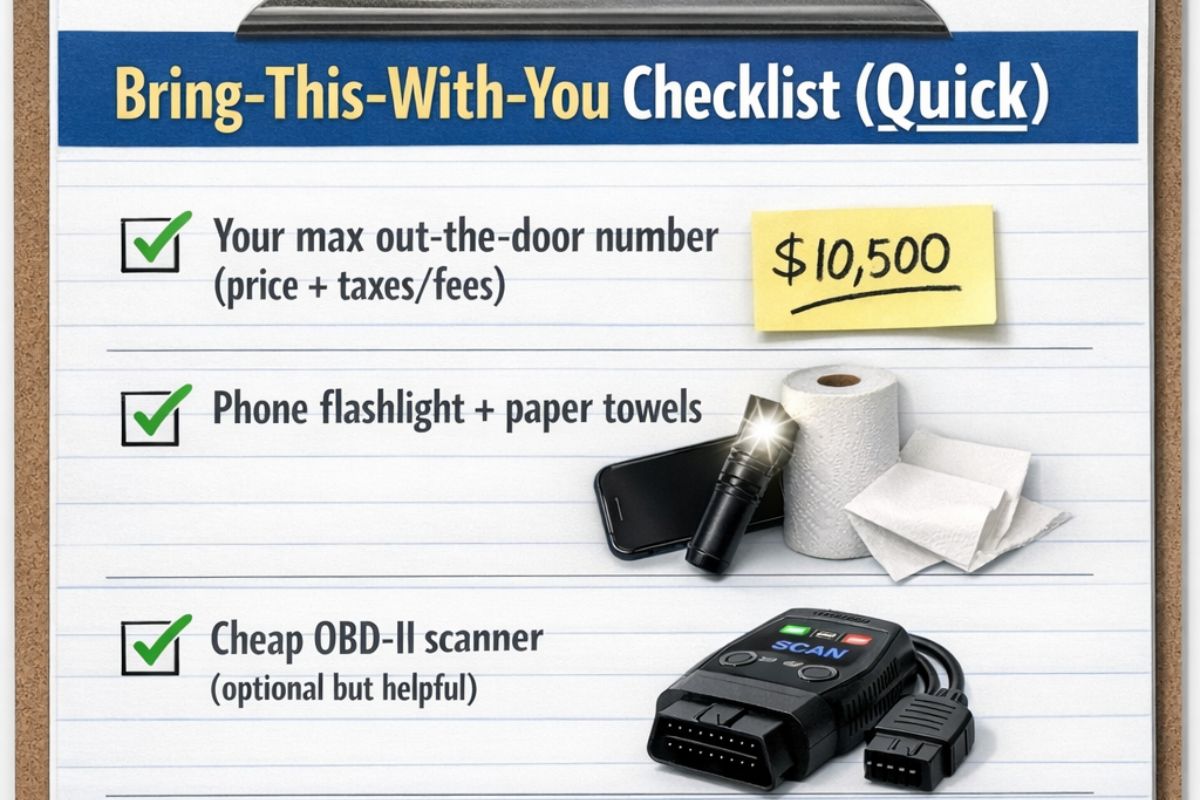
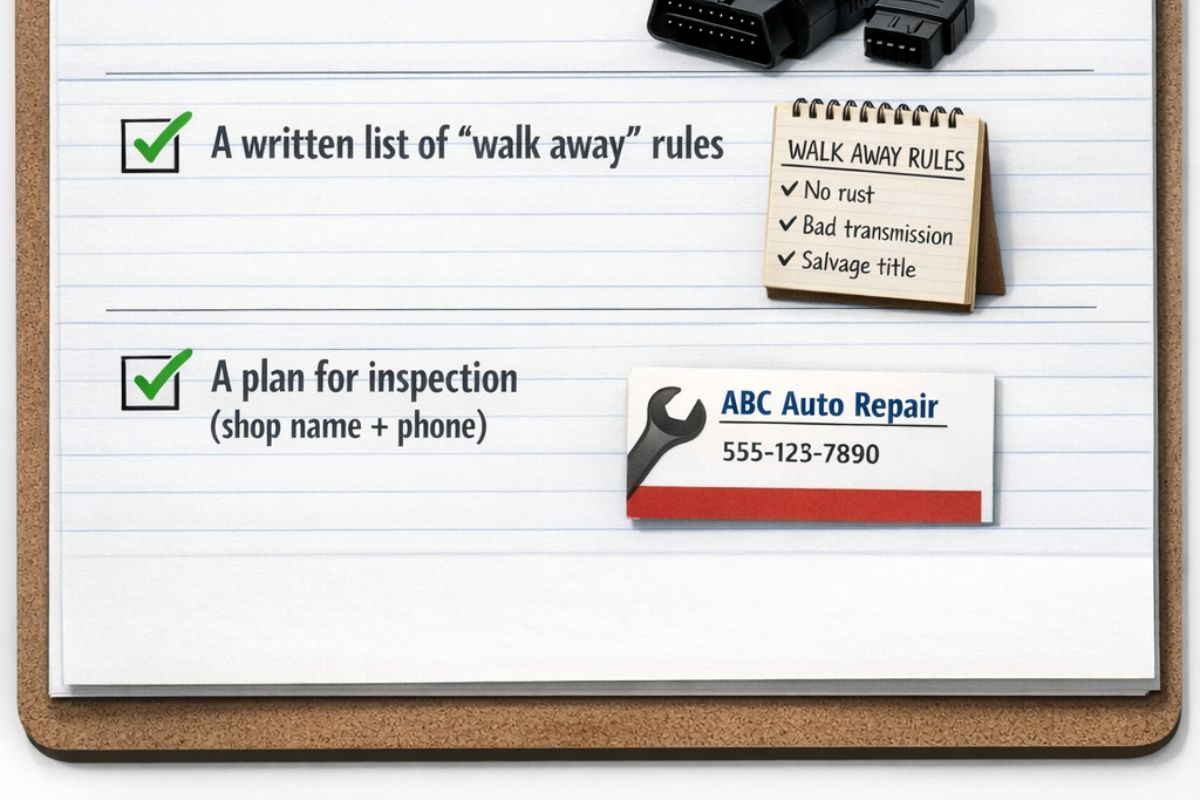
- Your max out-the-door number (price + taxes/fees)
- Phone flashlight + paper towels
- Cheap OBD-II scanner (optional but helpful)
- A written list of “walk away” rules
- A plan for inspection (shop name + phone)
Closing thought
At $6,000, you’re not hunting perfection—you’re hunting a car with predictable problems (tires, brakes, minor cosmetic issues) and avoiding unpredictable money pits (rust, flood, engine/cvt/transmission failures).
If you want, paste 2–3 listings you’re considering (miles, year, price, location, any photos/description) and I’ll help you triage them fast.