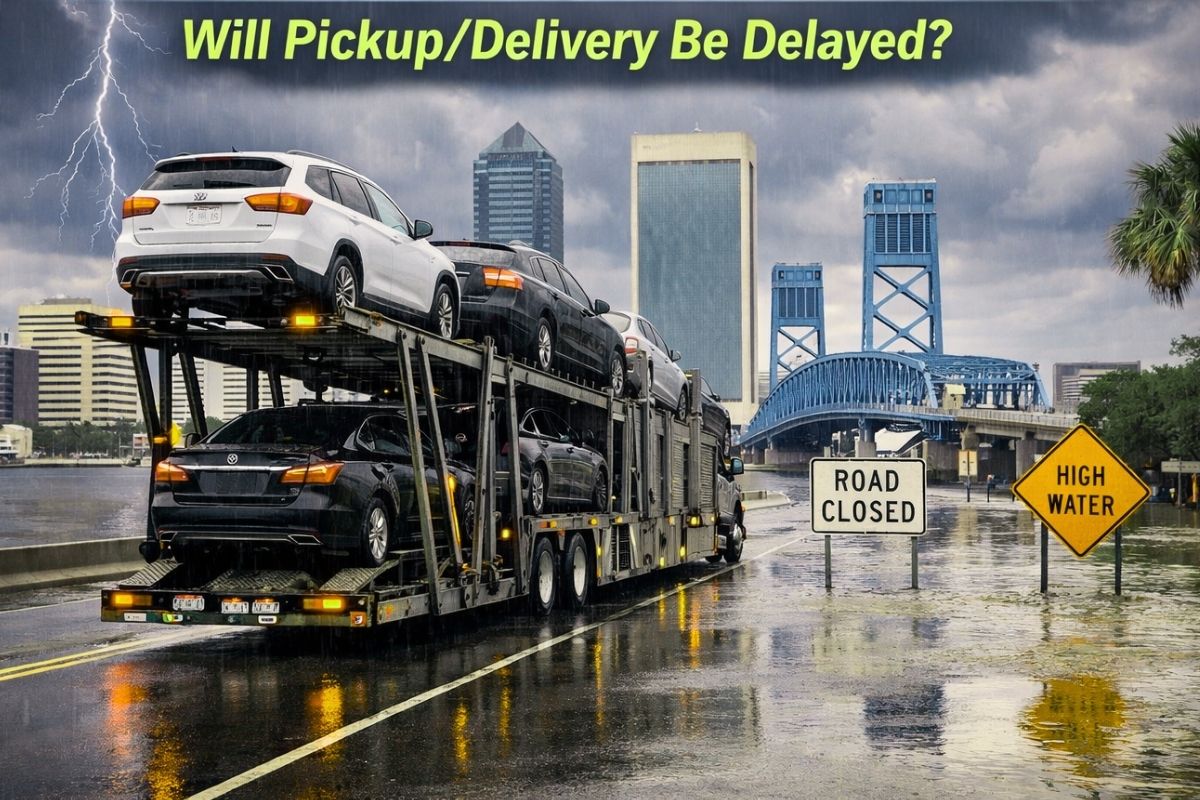

Key Takeaways
Will Jacksonville weather delay my car shipping pickup or delivery?
Sometimes. Light rain often won’t stop transport, but thunderstorms, lightning, strong winds, or flooding can trigger safety holds, route changes, or rescheduling to protect drivers and your vehicle. (National Weather Service)
What types of weather cause the biggest delays in Jacksonville?
The biggest disruptors are lightning-heavy storms, coastal flooding, high winds on exposed roads/bridges, and tropical systems. These conditions can make loading unsafe and force detours that stretch ETAs. (National Weather Service)
How can I tell if my shipment is likely to be delayed today?
Don’t look only at “chance of rain.” Check active advisories/warnings, local flooding info, and road closures/traffic. Then confirm with your dispatcher whether your route or pickup area is impacted. (National Weather Service)
Does Jacksonville Weather affect pickup more than delivery?
It can affect both. Pickup suffers when neighborhoods are hard for a car carrier to access safely, while delivery is impacted when flooded streets or severe storms reduce safe meeting-point options. (National Weather Service)
What’s the easiest way to reduce weather-related delays?
Use a flexible pickup window, keep your phone available, and choose an easy meeting point near major roads. Large parking lots can help avoid tight streets, construction zones, or flood-prone areas.
Should I book enclosed transport because of Jacksonville Weather?
Enclosed adds protection from road debris and exposure, but it won’t prevent delays if roads are unsafe. For most daily drivers, open transport is fine; enclosed fits high-value or fragile vehicles.
If there’s a delay, what should a professional company communicate?
You should get an updated ETA window, a clear reason (storm, flooding, closure), and a Plan B (new meeting point or rescheduled slot). Safety + Hours-of-Service constraints can also affect timing. (FMCSA)
Is a “random broker” my only option to ship to or from Jacksonville?
Not always. Some customers book carriers directly; others use brokers who arrange transport. Reduce risk by verifying DOT/MC, operating authority, and insurance filings using FMCSA tools before booking. (FMCSA)
👉 Need a broader guide beyond Jacksonville? See our Florida car shipping overview (pricing, timing, open vs enclosed, and what to expect statewide)
Table of Contents
Table of Contents
If you’re searching Jacksonville Weather right now, you probably want one answer: will my car shipping pickup or delivery be delayed? Most of the time, light rain won’t stop transport—but lightning-heavy storms, coastal flooding, or high winds can force safety holds, detours, and rescheduling.
That’s stressful when you have a flight, a closing date, or a tight moving window. And in Jacksonville, delays often happen not because the carrier is “late,” but because a large truck can’t safely access certain streets—or the route becomes unsafe.
In this quick guide, you’ll learn how to predict delays in minutes, what to check (alerts, flooding risk, road closures), what to ask your dispatcher, and how to reduce surprises with a flexible window and a smart meeting point near major corridors like I-95 and I-10.
Will Jacksonville weather delay my pickup or delivery?
Yes—delays are most likely when Jacksonville weather triggers alerts, flooding, or unsafe loading conditions, because carriers prioritize safety, legal driving limits, and access to your pickup/delivery location.
In real life, “weather delays” usually look like:
- Pickup shifts a few hours (waiting out lightning or heavy downpours).
- Pickup/delivery moves 24–48 hours (flooding, tropical impacts, widespread closures).
- Meeting point changes (your street is tight, low-lying, or blocked).
A helpful mindset: the forecast affects (1) safety to load/unload and (2) whether a large truck can physically reach you.
What Jacksonville weather conditions cause the biggest delays?
The biggest delay drivers are lightning-heavy thunderstorms, coastal flooding, high winds on exposed routes, and tropical systems—because they create real safety risks and force detours that consume driving hours.
Here’s what each one changes:
- Lightning / thunderstorms: loading is outdoors and often done on open pavement—if thunder is close, crews pause for safety.
- Coastal flooding / high tide flooding: some neighborhoods become inaccessible, so you switch to a higher, easier meeting point.
- High winds: large car haulers are more affected by gusts (especially bridges and open stretches).
- Tropical systems: schedules become “wait and see” because conditions and closures change rapidly.
How can I tell if my shipment is likely to be delayed today?
To predict delays, check for active NWS advisories/warnings, confirm local flooding risk, and review real-time road closures and incidents—then ask your dispatcher if the planned route or neighborhood access is affected.
5-minute “delay check” (copy/paste)
- NWS Jacksonville: look at Current Hazards and any active alert headlines.
- Lightning risk: if thunderstorms are active/approaching, assume loading may pause.
- Flooding: if you’re near low-lying/coastal areas, prepare a Plan B meeting spot.
- FL511 traffic + closures: accidents/closures compound weather delays fast. (FL511)
- Text/ask: “If my street is hard to access today, what meeting point do you recommend?”
What’s the easiest way to reduce weather-related delays?
You reduce delays by combining a flexible pickup window with an easy-access meeting point near major roads, keeping your phone available, and preparing the vehicle so loading is fast when weather breaks.
Fast checklist (what to do before pickup)
- Choose a 2–4 day window if weather is unstable.
- Offer a meeting point (big parking lot works great) if your neighborhood is tight or flood-prone.
- Keep keys ready and remove loose items.
- Have your contact available for quick coordination.
Common mistake
- Booking with a same-day mindset during stormy periods and refusing alternate meeting points (that’s how small weather issues become big delays).
Weather trigger → what happens → what to do
Snippet-ready rule: if your “address” becomes the problem, switch to a meeting point.
| Weather/road situation | What often happens | What you should do |
|---|---|---|
| Thunderstorms + lightning nearby | Loading pauses; ETA gets fuzzy | Stay ready; accept a wider arrival window; keep phone on. |
| Flood-prone streets / coastal flooding | Driver can’t safely reach your street | Offer a higher, wide meeting point (large parking lot). |
| Major crashes/closures on route | Detours consume driving hours | Check FL511; ask for updated ETA after reroute. |
| Adverse driving conditions | Driver may need to slow/stop; scheduling shifts | Expect reschedule; ask for the next realistic window. |
Should I book open or enclosed transport when Jacksonville Weather looks bad?
Enclosed helps protect the vehicle from road spray and debris, but it does not prevent delays when conditions make roads unsafe or loading risky—so choose enclosed for protection, not for speed.
Quick guidance:
- Open transport: best value for most daily drivers; expect normal weather exposure.
- Enclosed transport: best for high-value, classic, or delicate vehicles; fewer risks from road debris and weather exposure.
- In both cases, severe weather still affects schedule.
Open vs Enclosed (and what weather changes)
| Option | Best for | Weather advantage | What weather still impacts |
|---|---|---|---|
| Open | Most vehicles, best cost | None (exposed) | Storm holds, flooding access, detours |
| Enclosed | High-value/classic, strict condition | Less exposure to spray/debris | Storm holds, flooding access, detours |
Do I have to use a “random broker” to ship to/from Jacksonville?
No—some people book directly with carriers, while others use brokers who match loads to carriers, and your best protection is verifying authority, insurance, and clear communication policies before pickup.
A simple “anti-random” verification list:
- Confirm whether you’re booking a carrier or broker (ask directly).
- Request the carrier name + DOT/MC once assigned.
- Ask: “What happens if weather blocks access—meeting point or reschedule?”
- Keep everything in writing (ETA window, meeting point, cancellation terms).
Conclusion
Jacksonville weather doesn’t automatically mean delays—but alerts, lightning risk, flooding, and road closures absolutely can. If you want fewer surprises, plan for a window, prepare a meeting point, and use NWS + FL511 as your “today” dashboard.
Quick facts
- Property-carrying drivers may drive a maximum of 11 hours after 10 consecutive hours off duty.
- Drivers may not drive beyond the 14th consecutive hour after coming on duty (off-duty time doesn’t extend that window).
- Drivers can extend the 11-hour driving limit and 14-hour window by up to 2 hours when adverse driving conditions are encountered.
- If a broker’s available financial security falls below $75,000 and isn’t replenished within 7 calendar days, FMCSA can suspend the broker’s operating authority.